Tanzania, Hanyang University ERICA seek closer ties
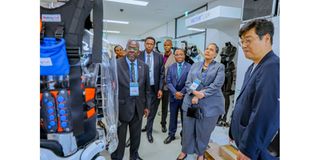
Finance Minister Khamis Mussa Omar (left) and Information, Communication and Information Technology Minister Angellah Kairuki (second right) listen to an explanation of academic programmes at Hanyang University ERICA during a visit to a robotics training facility in Seoul, South Korea. Also pictured are Tanzania’s Ambassador to South Korea, Noel Kaganda (centre); Acting Permanent Secretary in the Ministry of Finance and Commissioner for External Finance, Rished Bade (second left); and Assistant Commissioner in the Ministry of Finance’s External Finance Department, Melckzedeck Mbise (third left, rear).
Seoul. Tanzania is seeking to deepen cooperation with Hanyang University ERICA in South Korea, with the government proposing partnerships in artificial intelligence (AI), digital transformation, research and innovation.
Finance Minister Khamis Mussa Omar led a Tanzanian delegation to the university in Seoul on the sidelines of the Korea-Africa Economic Cooperation Ministerial Meeting (KOAFEC).
He was accompanied by Information, Communication and Information Technology Minister Angellah Kairuki.
Speaking during the visit, Mr Omar thanked the university for hosting the delegation and reaffirmed Tanzania’s commitment to strengthening ties with the institution.
Ms Kairuki described the visit as a strategic step towards building long-term cooperation, following previous visits by Tanzanian leaders to South Korea.
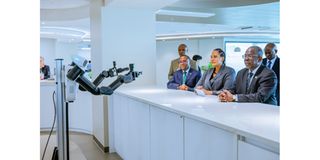
Finance Minister Khamis Mussa Omar (right), Information, Communication and Information Technology Minister Angellah Kairuki (centre), Tanzania’s Ambassador to South Korea, Noel Kaganda (left), and Assistant Commissioner in the Ministry of Finance’s External Finance Department, Melckzedeck Mbise (rear), examine a robot developed by Hanyang University ERICA during their visit to the university in Seoul, South Korea, on the sidelines of the Korea-Africa Economic Cooperation Ministerial Meeting (KOAFEC).
She said Hanyang ERICA’s expertise in AI and digital transformation aligned with Tanzania’s development priorities.
“The use of AI and digital transformation are key pillars of Tanzania’s development,” Ms Kairuki said, adding that the government was seeking to strengthen young people’s skills, data infrastructure and innovation systems under the National Development Vision 2050.
The minister proposed nine areas of cooperation, including signing a memorandum of understanding (MoU), student exchanges, training for academic staff and establishing a joint research centre to be known as the Korea-Tanzania Digital Innovation Lab.
She said the proposed partnership should produce tangible results, including skills development, laboratory construction and the establishment of start-ups.
Ms Kairuki also invited ERICA Vice President Baek Dong-hyun and his delegation to visit Tanzania, including Dodoma, Dar es Salaam and Zanzibar, to explore investment opportunities and assess the country’s capacity to support investment across various sectors.
Responding to the proposals, Prof Baek said they were important and practical.
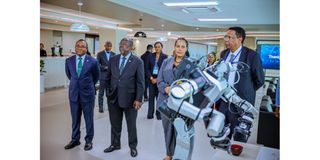
Finance Minister Khamis Mussa Omar (second left), Information, Communication and Information Technology Minister Angellah Kairuki (second right), Tanzania’s Ambassador to South Korea, Noel Kaganda (left), and Acting Permanent Secretary in the Ministry of Finance and Commissioner for External Finance, Rished Bade (right), examine a robot developed by Hanyang University ERICA during their visit to the university in Seoul, South Korea, on the sidelines of the Korea-Africa Economic Cooperation Ministerial Meeting (KOAFEC).
He said some of the initiatives could be implemented with relative ease because the South Korean government had already set aside funds for cooperation with Tanzania.
“This will help reduce some of the challenges that could arise in implementing the proposed initiatives,” he said.
Prof Baek said the university would study the proposals in detail and identify the best ways to implement them.
Hanyang University ERICA has a strong focus on research and technology, particularly AI, data science, robotics, cybersecurity and semiconductors.
The university works closely with industry and the technology sector and has developed an Industry-Coupled Problem-Based Learning (ICPBL) model.
It also operates modern distance-learning systems and facilities including the Campus Innovation Park and Ansan Science Valley.
The university is widely recognised for linking education, research and industry and has partnerships with institutions in several countries.