Tanzania orders referral hospitals to establish cancer units
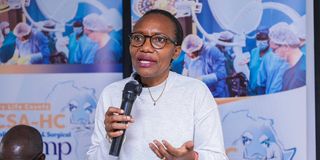
The Permanent Secretary in the Ministry of Health, Dr Grace Magembe, speaks during a visit to the ECSA-HC Specialised Medical and Surgical Camp at Mount Meru Regional Referral Hospital in Arusha. PHOTO | COURTESY
Arusha. The government has directed all regional and zonal referral hospitals in Tanzania to establish dedicated cancer diagnosis and treatment units as part of efforts to reduce cancer-related deaths and bring specialised services closer to communities.
The directive comes amid a rising cancer burden in the country, with about 44,931 new cases diagnosed annually and nearly 30,000 deaths recorded every year.
Statistics show Tanzania has a cancer incidence rate of 140.1 cases per 100,000 people, while the mortality rate stands at 97.1 deaths per 100,000 population.
Cervical cancer remains the most common cancer among women, while prostate cancer is the leading cancer affecting men.
The Permanent Secretary in the Ministry of Health, Dr Grace Magembe, issued the directive during her visit to the ECSA-HC Specialised Medical and Surgical Camp at Mount Meru Regional Referral Hospital in Arusha.
Dr Magembe said the increasing demand for cancer services requires referral hospitals to establish oncology units to ensure patients can access diagnosis and treatment closer to their homes.
“The demand for cancer services is increasing, and cancer-related deaths continue to rise. Referral hospitals should establish cancer treatment units within their facilities to make these services more accessible to the public,” she said.
She said the units would provide diagnosis and treatment services while also serving as centres for public education on cancer prevention, risk factors and healthy lifestyles.
“These centres will play a vital role in educating the public about cancer risk factors, including unhealthy diets, harmful products and lifestyle practices that increase the risk of developing cancer,” she said.
Dr Magembe urged healthcare workers to encourage people visiting health facilities for treatment, routine check-ups or accompanying patients to undergo cancer screening.
She said early detection improves treatment outcomes and reduces the cost and complexity of care.
“Many patients seek medical attention only when the disease has reached advanced stages, making treatment more difficult, expensive and less successful. Early diagnosis greatly increases the chances of recovery,” she said.
She also called for increased awareness to encourage more men to undergo prostate cancer screening, saying many still seek medical attention only after the disease has progressed.
Dr Magembe commended the East, Central and Southern Africa Health Community (ECSA-HC) for organising the specialised medical camp, saying it had enabled low-income patients to access life-saving surgical and diagnostic services.
ECSA-HC Director General Dr Ntuli Kapologwe said the organisation had invested more than Sh260 million to support medicines, specialist services and the operation of the camp.
He said the initiative aims to save lives, reduce waiting times for specialised treatment and strengthen healthcare workers’ skills through knowledge sharing.
The Arusha camp is being conducted alongside similar specialised surgical camps in Mtwara and Malawi. The two Tanzania-based camps are expected to provide surgical treatment to more than 500 patients with various medical conditions.
Dr Kapologwe said the programme supports the government’s efforts to achieve Universal Health Coverage (UHC) by providing specialised care to patients, some of whom have waited months or years for surgery.
Meanwhile, Acting Medical Officer in Charge at Mount Meru Regional Referral Hospital, Dr Kipapi Mlambo, said the camp had attracted strong demand from residents in Tanzania’s Northern Zone.
He said more than 1,000 people had received medical services, while 150 patients had undergone surgical procedures performed by 13 specialist doctors involved in the programme.
Dr Mlambo said the initiative had expanded access to specialised healthcare services for patients who would otherwise struggle to obtain or afford complex surgical treatment.