Josephine Christopher is a senior business journalist for The Citizen and Mwananchi newspapers
Mwananchi Communications Limitted
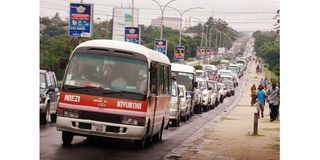
Dar es Salaam. Traffic jams in Dar es Salaam are more than a daily nuisance; they are an economic drain measured in lost hours, money and productivity.
Research indicates that workers in Tanzania’s commercial capital lose an average of 2.5 hours each day stuck in traffic.
According to a 2016 study by urban researcher Hosea Mpogole, this is equivalent to almost three days of lost productivity in every ten working days.
Other studies underscore the wider impact of congestion on households and businesses.
A 2021 study titled Effects of Roads Traffic Congestion on Economic Activities of Dar es Salaam Region in Tanzania by Dr Laurencia Massawe found that long travel times inflate fuel costs.
It also revealed that some low-income workers spend up to 39 percent of their income on transport fares, often paying multiple fares for a single commute.
For decades, expanding road networks has been the most visible response to congestion.
New highways, additional lanes and flyovers are seen as the quickest way to move more vehicles through crowded corridors.
However, transport experts argue that the city’s daily gridlock is not solely due to insufficient roads; it reflects deeper structural factors shaping one of Africa’s fastest-growing cities.
Dr Elvis Emmanuel of the College of Engineering and Technology (CoET) at the University of Dar es Salaam (UDSM) cautions against expecting a single grand solution.
“There are many documented strategies for reducing traffic congestion. It is not a single-solution issue,” he told The Citizen.
Road widening can offer short-term relief, Dr Emmanuel noted, but benefits often fade as cities expand and vehicle ownership rises.
As more roads are built, more cars tend to fill them, a phenomenon observed worldwide in rapidly urbanising cities.
The deeper issue, he said, lies in the city’s development patterns, noting that much of Dar es Salaam’s economic activity remains concentrated in a few central districts, creating heavy daily traffic flows.
“In the morning, large numbers of commuters travel toward the same areas where offices, businesses and government services are located. In the evening, the flow reverses,” he explained.
“This pattern creates intense pressure on key corridors during peak hours. Decentralising commercial hubs would reduce that pressure,” he added.
The dean of the Faculty of Logistics and Business Studies at the National Institute of Transport (NIT), Dr Prosper Nyaki, described congestion as a dynamic system shaped by evolving economic and social forces.
“Traffic congestion is not a static problem. The factors driving congestion change over time, which means solutions must also evolve. Cities cannot apply a single intervention and expect the problem to disappear permanently,” he said.
Dr Nyaki added that population growth remains a key driver, noting that as Dar es Salaam expands, the number of daily trips increases and that people are travelling to work, markets, hospitals, schools and social services.
According to him, economic growth also intensifies the movement of goods across the city.
“Industries require raw materials and transport networks to distribute finished products. Businesses depend on logistics systems to connect suppliers, retailers and consumers. As manufacturing and trade grow, so does the volume of vehicles transporting goods,” Dr Nyaki said.
He said the rising number of private vehicles compounds the pressure, noting that even when roads are widened, increasing car ownership quickly absorbs new capacity.
“You may expand a road or add lanes. But over time, congestion may return because more vehicles enter the system,” Dr Nyaki warned.
For this reason, he said modern urban transport management relies on a combination of strategies rather than a single infrastructure project.
He said the Dar es Salaam’s Bus Rapid Transit (BRT) system has begun shifting commuter patterns by offering faster, more reliable travel along dedicated lanes.
However, experts say the long-term impact depends on expanding capacity and service quality.
“Public transport must be reliable, comfortable and dignified. If people feel overcrowded or inconvenienced, they will choose private cars,” said Dr Emmanuel.
Expanding the BRT fleet, improving passenger comfort and strengthening feeder networks connecting neighbourhoods to main corridors could persuade more commuters to leave their cars at home.
Dr Emmanuel said rail transport could also play a larger role as high-capacity commuter trains linking residential areas with major economic hubs could move thousands of passengers at once, easing pressure on busy roads.
“Such systems are common in large metropolitan areas, complementing road transport rather than competing with it,” he observed.
Digital solutions and behaviour change
Online commerce platforms already allow consumers to order goods remotely rather than visiting markets.
Digital payment systems and mobile banking have similarly reduced trips to financial institutions.
“Today, people can order goods online and have them delivered instead of travelling to markets like Kariakoo,” said Dr Nyaki, noting that mobile money and online banking have already cut the need for many physical transactions.
He said expanding digital services could therefore reduce daily travel demand across the city.
Furthermore, Dr Nyaki said ride-hailing platforms offer a more efficient alternative to private car ownership by allowing vehicles to serve multiple passengers rather than remaining idle for much of the day.
He stressed that advances in communication technology are enabling remote work and online education in some sectors, reducing commuting altogether.
Urban planners say these changes could gradually reshape how people move through cities.
Traffic and highway surveillance cameras
In 2023, the government sought a contractor to install traffic and highway surveillance cameras along major roads in Dar es Salaam and Morogoro regions to monitor speeding vehicles, road accidents and curb crime incidents.
Senior police officer Meloe Buzana announced that cameras would be installed once a suitable contractor, either local or foreigner was found.
“Both domestic and international contractors have expressed interest. We are analysing the applications to select the best agency with reliable facilities and favourable terms,” he said.
A private consultant in transport, logistics and business issues residing in Dar es Salaam, Dr Sarun Namonga, said the initiative was vital in addressing nuisances and violations committed by unscrupulous drivers and other road users.
“Unfortunately, the government’s promise remains unfulfilled despite the world’s fast shift to digitalization. Reliance on traffic officers at multiple city points would significantly decline,” he said.
“Currently, traffic officers are often blamed for causing jams and engaging in petty corruption, sometimes extracting as little as Sh2,000 from commuter bus operators, commonly known as daladala,” he added during a telephone interview.
He said for cities like Dar es Salaam, the combination of infrastructure, technology and innovative thinking may finally offer a path to smoother, safer and more efficient transport.
Efforts to reach Latra for an update on the camera installation were unsuccessful up to the time of going to press yesterday.
Sh10 million for actionable proposal
However, there is emerging hope as the government is seeking innovative solutions from Tanzania’s next generation of engineers.
Works Minister, Mr Abdallah Ulega, has pledged Sh10 million to university students who submit actionable proposals addressing Dar es Salaam’s transport challenges.
Beyond the cash prize, winners will have the opportunity to register companies to implement their ideas, turning research into real-world solutions.
“Young people who write solutions to the challenges we face will receive Sh10 million,” said Mr Ulega, framing congestion not just as a problem but as an opportunity for innovation.
For a city struggling with gridlock, it is a rare chance to convert frustration into strategy and perhaps finally transform the way Dar es Salaam moves.
Register to begin your journey to our premium contentSubscribe for full access to premium content