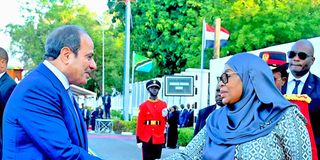
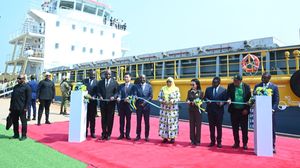
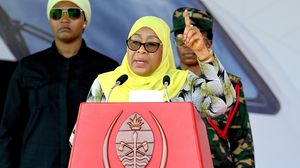
President Samia Suluhu Hassan bids farewell to Egyptian President Abdel Fattah El-Sisi at State House in Dar es Salaam on Saturday following the conclusion of his one-day state to Tanzania. PHOTO | STATE HOUSE
Dar es Salaam. The agreements unveiled by Presidents Samia Suluhu Hassan and Abdel Fattah El-Sisi on Saturday may have been announced during a state visit, but their implications extend well beyond diplomacy, The Citizen has learnt.
They represent a strategic attempt to reposition Tanzania and Egypt as economic gateways linking East Africa, North Africa, the Middle East and Europe through trade, transport and investment, while advancing Africa’s integration agenda under the African Continental Free Trade Area (AfCFTA).
At the heart of the new partnership is a shared acknowledgement that commercial ties have failed to keep pace with the strong diplomatic relationship enjoyed by the two countries.
Although Egypt is already Tanzania’s eighth-largest source of foreign investment, with 61 projects worth about $1.5 billion employing more than 4,000 Tanzanians, both Heads of State agreed that bilateral trade remains far below its potential.
President Hassan made that ambition clear, noting, “We both agreed that the level of trade between our two countries is still low, yet there is enormous potential for growth. We have therefore agreed to expand trade, while also promoting greater investment between our nations.”
Tanzania’s Foreign Affairs and East African Cooperation Minister, Mr Mahmoud Thabit Kombo, said the agreement goes beyond increasing trade volumes and rather.
“It sets out a framework for cooperation in agriculture, livestock, transport, energy, pharmaceuticals, logistics, port development and technology transfer,” he added.
Agriculture is among the clearest examples of the partnership’s complementary strengths.
President Hassan underlined the opportunity by saying, “Tanzania has more than 29 million hectares suitable for irrigated agriculture and we also have the second-largest livestock population in Africa. Egypt has made significant progress in irrigation technology and seed production. We have agreed to work together to develop this sector.”
The roadmap also stands out because it is accompanied by an implementation plan.
President El-Sisi echoed that commitment by announcing Egypt’s readiness to support Tanzania’s institutional capacity.
“We will utilise all our capabilities to expand programmes for exchanging experience and building the capacity of Tanzanian officials in various areas of development.”
He also reaffirmed Egypt’s commitment to improving maritime connectivity.
“We have expressed our readiness to cooperate in port development, logistics services and the establishment of maritime transport links between Egypt and Tanzania to facilitate trade and the movement of goods.”
The business forum
During the Tanzania-Egypt Business Forum, Transport Minister Makame Mbarawa announced that the two countries are in the final stages of establishing a cargo transport hub linking the Port of Dar es Salaam with Egypt’s Ain Sokhna Port, creating a maritime logistics corridor stretching across the Indian Ocean, the Red Sea and the Mediterranean.
Prof Mbarawa described the corridor as more than a transport project. “This hub will open a new trade route linking Sub-Saharan Africa, North Africa, the Middle East, Europe and other global markets,” he said.
Prof Mbarawa also revealed that implementation is already under way.
“I’m pleased to announce that, under the coordination of experts from the Ministry of Transport, Tanzania will visit Egypt later this month to conclude discussions and formally finalise the project.”
The transport corridor is expected to complement Tanzania’s expanding logistics infrastructure, including the upgraded Dar es Salaam Port, the Standard Gauge Railway and improved trunk roads.
Together, these investments could lower transport costs, improve supply chains and strengthen Tanzania’s position as a regional logistics hub serving neighbouring land-linked countries.
Egypt’s Investment and Foreign Trade Minister, Mr Hassan El Khatib, also emphasised that the partnership is intended to create opportunities for businesses rather than governments alone.
“We have made significant progress in our cooperation, but we need to do more to expand trade and investment for the benefit of our people,” he said.
The economic significance extends beyond the two countries. By connecting East Africa with North Africa and the Mediterranean, the initiative complements the objectives of the AfCFTA, whose success depends not only on removing tariffs but also on improving infrastructure, logistics and market connectivity.
Dr Ahmed Buchoza of the University of Dodoma argues that the partnership should be viewed within Africa’s broader geopolitical landscape.
In his assessment of regional integration, stronger economic links between East and North Africa reduce dependence on overseas markets while enhancing Africa’s collective bargaining power in global trade.
“The proposed transport corridor demonstrates how infrastructure is becoming an instrument of economic diplomacy.
Trade figures already demonstrate the breadth of opportunities available. Tanzania exports tea, sisal, tobacco, cashew nuts, cement and copper ores to Egypt, while importing industrial chemicals, fertilisers, petroleum products, construction materials and pharmaceuticals.
Better transport connectivity and increased investment could significantly diversify this trade basket while encouraging value addition and industrial production.
Register to begin your journey to our premium contentSubscribe for full access to premium content