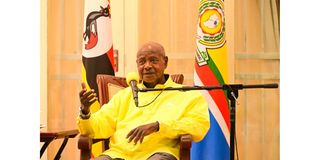
Dar es Salaam. Ugandan President Yoweri Museveni begins a two-day working visit to Tanzania today, as the two countries seek to strengthen bilateral ties.
The August 5–6 visit marks President Museveni’s second trip to Tanzania this year, coming six months after his February working visit during which he and President Samia Suluhu Hassan pledged to fast-track a series of strategic infrastructure, transport and energy projects.
“The discussions will focus on strengthening bilateral cooperation in a range of areas, including trade and investment, infrastructure and transport, energy, tourism, defence and security, and regional integration,” the Ministry of Foreign Affairs and East African Cooperation said in a statement yesterday.
The visit aims to further strengthen the longstanding historical, fraternal and diplomatic relations between Tanzania and Uganda, it said, adding that the two leaders will also review progress in implementing strategic projects and discuss measures to remove barriers affecting trade, investment and economic cooperation between the two countries.
Analysts speculate that the leaders will focus on accelerating key cross-border infrastructure projects and reviewing progress on the East African Crude Oil Pipeline (EACOP), among other things. The flagship EACOP project has moved significantly closer to completion. During an inspection of the project in Tanga on June 29, Energy Minister Deogratius Ndejembi announced that construction had reached 86 percent, with completion expected this month. He also said the first crude oil shipment from Chongoleani Port is now expected in January 2027, replacing the earlier target of July 2026.
“The minor challenge we identified is that electricity lines have not yet reached the project site. I have directed the contractor, through TANESCO, to ensure the work is completed before the contract deadline,” he said.
The $6 billion EACOP project stretches about 1,443 kilometres from Hoima in western Uganda to Chongoleani in Tanga and is expected to become the world’s longest heated crude oil pipeline. According to the government, construction has already created about 10,000 jobs, with approximately 7,500—equivalent to 75 percent—going to Tanzanians.
Beyond EACOP, the two governments are also pursuing a proposed natural gas pipeline from Tanzania to Uganda, a refined petroleum products pipeline to Tanga, expansion of the ports of Dar es Salaam, Tanga and Mtwara, and railway projects intended to improve regional connectivity and lower transport costs.
An economist at the University of Iringa, Mr Samson Rutashobya, said the visit is likely to concentrate on ensuring the remaining work on EACOP and other strategic projects is completed on schedule. He added that the talks could also culminate in the signing of new agreements on other bilateral projects, particularly the proposed natural gas pipeline and the Standard Gauge Railway (SGR) connection between the two countries. “The relationship between Tanzania and Uganda has increasingly shifted from political goodwill to implementation of large economic projects. This visit offers an opportunity for the two leaders to assess progress, resolve remaining bottlenecks and ensure the agreed projects deliver the expected economic benefits,” he said.
He added that successful completion of EACOP would strengthen investor confidence while positioning Tanzania as a major regional energy and logistics hub.
The Executive Director of the Research on Poverty Alleviation (Repoa), Dr Donald Mmari, said regular high-level engagements demonstrate both countries’ commitment to translating bilateral agreements into measurable economic outcomes.
“Major infrastructure projects require continuous political oversight because they involve multiple institutions and cross-border coordination. The visit provides an opportunity to review implementation while discussing wider trade, investment and industrial cooperation,” he said.
According to him, improved transport and energy infrastructure could significantly reduce business costs and stimulate trade throughout the East African Community.
Foreign policy analyst and political scientist at the University of Dar es Salaam, Mr Salbinus David, said the visit also carries important diplomatic significance.
“Tanzania and Uganda are among the region’s most influential countries. Frequent consultations between their leaders strengthen cooperation not only on bilateral projects but also on regional peace, security and East African integration,” he said.
Mr David noted that the second visit within a single year reflects the strategic importance both governments attach to their partnership, particularly as major infrastructure projects approach completion.
A public administration and political analyst at the State University of Zanzibar, Prof Makame Ali Ussi, said presidential diplomacy has become increasingly important in ensuring regional flagship projects remain on course.
“Large cross-border investments require sustained political commitment. Regular meetings between heads of state help maintain momentum, resolve emerging challenges and reinforce confidence among investors and development partners,” he said.