What UDOM’s Njombe campus means for higher education sustainability drive
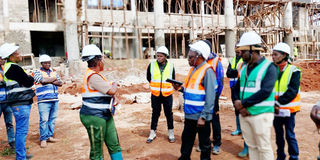
The Vice Chancellor of the University of Dodoma, Prof Lughano Kusiluka (third right, in a blue and orange hi-vis vest), listens to site foreman Ms Teopista Mgani during an inspection of the administration block under construction at the UDOM’s Njombe Campus. All six buildings at the site are scheduled for completion by May 26 this year. PHOTO | JACOB MOSENDA
Njombe. Tanzania’s ambition to take higher education closer to its people is steadily taking shape in the Southern Highlands, as the University of Dodoma (UDOM) intensifies construction of its first-ever campus in Njombe Region.
The campus, being constructed under the government-backed Higher Education for Economic Transformation (HEET) project and valued at Sh20 billion, according to local experts, is a strategic intervention in a country where access to university education has for decades been geographically uneven.
The project, which began in May 2025, is contractually scheduled for completion on May 26 2026, just weeks before the national deadline of June 2026 set for all HEET beneficiaries across the country.
Upon completion, the Njombe campus is expected to admit at least 1,000 students in the 2026/27 academic year, marking a turning point for a region that has long watched thousands of its young people migrate to Dar es Salaam, Dodoma and Mwanza in search of limited university slots.
During an inspection visit on February 18, 2026, UDOM Vice Chancellor Prof Lughano Kusiluka expressed confidence that the project could be completed three months ahead of schedule.
“This is a very encouraging stage of implementation. Despite the initial challenges, the contractor has intensified the pace of work, and we are confident the project will be completed within the agreed timeframe,” he said.
Prof Kusiluka stressed that meeting the May 2026 completion date is non-negotiable, given the national June 2026 HEET deadline.
“We have no option but to deliver this project on time. It is a strategic investment aimed at strengthening higher education and contributing to national development,” he emphasised.
The Vice Chancellor directed both the project consultant and contractor to increase manpower immediately, secure construction materials in advance and maintain day-and-night shifts to safeguard the timeline.
He also underscored the importance of strict financial discipline.
“These funds are dedicated to transforming higher education. We must ensure value for money and tangible results that will benefit students and the wider community,” he said.
What is being built?
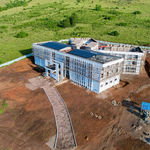
The 110-acre site, allocated by Njombe Regional authorities, will host an administration block, lecture theatres, modern laboratories, a library, a cafeteria and a dispensary.
The contractor says the project will complete as on time.
“The contract clearly states that the project must be completed by May 26, 2026. To achieve this target, we are increasing manpower and reorganising our work schedule to accelerate progress,” said the Dimetoclasa Real Hope Ltd Managing Director, Mr Dickson Mwipopo.
He acknowledged that the project faced nearly two months of disruption due to material shortages and logistical miscalculations.
He noted that the election period also slowed production in some manufacturing industries, affecting supplies of steel and aggregates.
“Currently, production has stabilised, materials are available, and with round-the-clock operations, we are confident we will meet the deadline,” Mr Mwipopo said.
A reform beyond bricks and mortar
The HEET project, financed through a World Bank facility, is one of Tanzania’s most ambitious higher education reforms in recent years.
Its goal is to expand infrastructure, modernise laboratories and learning facilities, strengthen science, technology, engineering and mathematics (STEM) programmes, and enhance universities’ capacity to drive economic transformation.
Nationally, HEET is supporting public universities to expand enrolment, upgrade teaching and research infrastructure, and align academic programmes with Tanzania’s industrialisation agenda.
For years, access to higher education has been concentrated in a few urban centres. Data from the Tanzania Commission for Universities (TCU) show that enrolment has grown significantly over the past decade, but demand continues to outstrip supply, particularly in science-based programmes.
Regions without university campuses have historically experienced lower transition rates from secondary to tertiary education.
Students from Njombe, Ruvuma and neighbouring areas often face financial and social barriers associated with relocation to distant cities.
The establishment of UDOM’s Njombe campus directly responds to this imbalance.
An education policy analyst based in Njombe, Dr Rehema Mhando, said the campus carries transformative potential for the region.
“For years, our brightest students have had to leave Njombe to access university education. Many never return. Establishing a campus here changes that dynamic,” she said.
“This is not just about 1,000 students. It is about building a knowledge economy in the Southern Highlands. Local businesses will grow, innovation will increase, and the region’s human capital will improve.”
She added that decentralising higher education is essential if Tanzania is to achieve equitable development.
“When higher education remains concentrated in a few cities, regional disparities widen. HEET is attempting to correct that imbalance. The real test will be sustainability beyond infrastructure—quality teaching, strong programmes and industry linkages,” she said.
Register to begin your journey to our premium contentSubscribe for full access to premium content