When stadiums inadvertently shut out people with disabilities
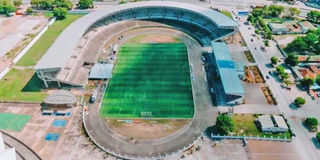
A bird’s-eye view of Uhuru Stadium in Dar es Salaam. Persons with disabilities in Tanzania continue to face significant barriers in accessing and using sports stadiums due to infrastructural inadequacies. PHOTO | FILE
Dar/Arusha. Persons with disabilities in Tanzania continue to face significant barriers in accessing and using sports stadiums due to infrastructure that fails to accommodate their needs, effectively excluding them from social life despite laws that promote inclusion and equality.
A three-month (October to December 2025) investigation by The Citizen, conducted in Dar es Salaam and Arusha regions, has found that many sports stadiums, particularly those hosting football matches, are not designed to serve people with physical, visual or hearing impairments.
Long staircases without alternative access routes, a lack of ramps, unfriendly toilets and seating areas with no space for wheelchairs are among the obstacles that force some fans among people with disabilities to remain outside stadiums or abandon sporting events altogether.
Some persons with disabilities say the situation denies them their right to enjoy sports like other Tanzanians, especially football, the country’s most popular sport that draws thousands of supporters.
What the law says
Tanzania has legal frameworks intended to safeguard the rights of persons with disabilities, including the Persons with Disabilities Act of 2010, which clearly outlines the responsibility of the government and both public and private institutions to ensure that public infrastructure, including sports stadiums, is accessible and usable by all without discrimination.
The law underscores equal access to social services, recreation and sports, as well as the duty to make reasonable adjustments where required.
Tanzania is also a signatory to the United Nations Convention on the Rights of Persons with Disabilities, which obliges member states to ensure the full participation of persons with disabilities in social life, including sports and recreation.
The Convention was adopted in 2006; Tanzania signed it in March 2007 and ratified it in November 2009.
The Constitution of the United Republic of Tanzania further guarantees equality and freedom from discrimination, meaning all citizens should enjoy equal opportunities to take part in social activities, including sports and entertainment.
In essence, the law grants persons with disabilities the full right to enter sports stadiums, sit safely and participate as fans or athletes without environmental barriers.
However, enforcement remains weak, particularly in the sports sector. Stadium construction and renovation projects have often prioritised commercial interests, general security and international standards, while paying limited attention to the needs of persons with disabilities.
The reality on the ground
The Citizen’s three-month investigation into stadiums such as KMC Complex, Azam Complex and Uhuru Stadium in Dar es Salaam found that, despite hosting Mainland Premier League matches and other competitions, they do not adequately cater for persons with disabilities.
By contrast, Sheikh Amri Abeid Stadium in Arusha offers some relief, with two access routes that persons with disabilities can use to reach the VIP stands.
Even so, similar facilities are absent in the main VVIP stand and other side stands.
Many stadiums built before 2000 offer no access at all for persons with disabilities, while those constructed later provide some facilities, but not comprehensively.
Benjamin Mkapa Stadium in Dar es Salaam, whose construction started in 2005 and ended in 2007, is Tanzania’s largest, with a capacity of 60,000 spectators.
Unlike most stadiums, it has several facilities for persons with disabilities, including access routes and lifts to the VVIP stand.
Nevertheless, it still lacks internal access routes enabling persons with disabilities to reach seating areas within the stands.
Because most stadiums lack designated access routes, persons with disabilities are often forced to mix with crowds, exposing them to safety risks when entering or leaving venues.
“When you arrive at the stadium, you realise you were never considered. Even if you get inside, there is nowhere you can sit safely and still enjoy the match,” says a football fan with a physical disability in Dar es Salaam who spoke on condition of anonymity.
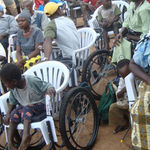
The investigation also established that, due to these challenges, some fans exploit persons with disabilities to gain free entry to stadiums by volunteering to push their wheelchairs through vehicle gates to avoid paying entrance fees.
As those gates are not intended for spectators, some end up being turned away, facing further difficulties once inside.
In some cases, fans volunteer to carry persons with disabilities up staircases to help them reach seating areas.
A resident of Arusha with a physical disability, Mr Amiri Said, recounts being injured at Sheikh Amri Abeid Stadium after crowd disturbances erupted during the Azam Federation Cup final between Yanga and Coastal Union that took place on July 2, 2022.
He says his hands were injured and his phone damaged in the chaos, prompting him to stop attending matches for fear of getting hurt, as he cannot access seating areas that guarantee his safety.
“When you look at those side stands,” he says, pointing, “if you try to enter from the back, police stop you, so it was difficult to reach where we were meant to sit,” he says.
“My colleagues helped me sit in a stand we were not assigned to. When the disturbances started, I was injured and my phone broke. Now I stay at home and watch matches on television,” he adds.
The investigation further found that stadium toilets fail to meet the needs of persons with disabilities, forcing some to step into or touch dirty surroundings, exposing them to health risks.
A football fan with a physical disability in Dar es Salaam, Mr Albert Kiwela, says stadiums have failed to provide appropriate sanitation facilities, often forcing him to step into dirty water.
“We have the right to proper services. Even entering stadiums requires help and once inside we are still at risk of falling sick,” he says.
Stadium managers speak out
KMC Stadium manager Hussein Kitundura acknowledges the challenges in providing services for persons with disabilities, saying improvements are ongoing.
“The stadium is not yet complete as planned by Kinondoni Municipal Council, but due to demand it started being used. Construction is still continuing in phases,” he says.
“The council’s goal is to ensure the stadium meets the needs of all user groups,” he adds, noting that stakeholders have been engaged to advise on further modernisation.
At Sheikh Amri Abeid Stadium, built in 1975, manager Emmanuel Loi admits there are gaps in implementing laws meant to protect persons with disabilities.
He says that as preparations continue for the 2027 Africa Cup of Nations finals, to be co-hosted by Tanzania, Kenya and Uganda, the needs of persons with disabilities will be addressed.
“This stadium was built long ago and even renovations then did not consider these needs. The two special access routes were added after we saw persons with disabilities sitting inside the fence, which was unsafe,” he says.
He adds that front seats are reserved for persons with disabilities, but acknowledges there is no access route to the VVIP area, which is only reachable by stairs.
“We will soon renovate the stadium. The government has allocated enough funds for major upgrades ahead of Afcon and through those works we will consider the needs of persons with disabilities,” he says.
As Tanzania continues to invest in sports, debate over inclusive infrastructure is gaining momentum to ensure no one is left outside the stadium because of disability.
Register to begin your journey to our premium contentSubscribe for full access to premium content