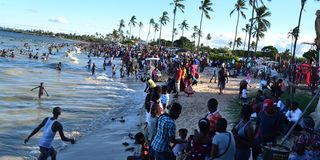
Dar es Salaam. Coco Beach, one of the most prominent public shorelines in Dar es Salaam, has once again stirred public emotion and controversy with renewed attempt at redevelopment.
The latest episode, which has ignite fresh tensions between authorities and small traders, compelled Prime Minister, Mwigulu Nchemba, to visit the beachfront over the weekend.
His visit, aimed at calming traders followed widespread rumours that redevelopment plans were advancing without proper explanation to those operating businesses along the shoreline.
Speaking to traders and residents gathered at the beach, Dr Nchemba firmly dismissed claims that the area was being sold.
“Coco Beach is not for sale. Let me remove your fears. This place will not be sold. There is no investor other than you yourselves. No one will come with directives beyond those already issued by President Samia Suluhu Hassan,” he said.
At the centre of the current dispute are small-scale traders operating along the beachfront. Several claim they received a 30-day eviction notice from Kinondoni Municipal officials.
They argue the directive was abrupt and lacked consultation. The traders’ chairperson, Almas Masia Victor, said the process was opaque.
“We were told to leave without even questioning. But this is public land. We pay our taxes and have been recognised by the government. Why should we be removed?” he said.
He added that traders were asked to sign documents. They were also offered compensation of about Sh1 million. The offer was rejected by many. “Why compensate us if nothing is happening behind the scenes? This is a public resource. It cannot be sold,” he said. Mr Victor warned that displacement could have broader social consequences.
“When you remove people from their businesses, where do they go? You risk creating hardship that may later manifest in crime,” he said.
The current tensions reflect a long and contested history. In 2005, Kinondoni Municipal Council initiated plans to redevelop the area.
The move attracted investors. It also triggered legal disputes that stalled progress. By 2007, a memorandum of understanding had been signed. By 2009, the matter had reached the High Court following delays and disagreements.
Another major episode emerged between 2015 and 2017. It involved the late businessman Yusuf Manji. His company had taken interest in the site. However, the project was later halted. Intervention by the late President John Magufuli proved decisive. He declared that the beach should remain accessible to the public.
“Recognising the government’s directive, we obey the order and leave the area for public use,” Mr Manji said at the time. Since then, authorities have sought to strike a delicate balance. Efforts have focused on improving infrastructure while preserving public access.
In 2018, then Prime Minister Kassim Majaliwa directed officials to enhance security and sanitation. He also encouraged structured economic activity along the shoreline. President Hassan later reinforced this approach. She oversaw the establishment of stalls for small traders. The initiative acknowledged their contribution to the local economy.
It also aimed to formalise their operations. However, traders now say those assurances appear uncertain.
“We were given these spaces by the President herself. If anything has changed, let her come and tell us directly,” Mr Victor said. Authorities maintain that redevelopment remains necessary. Kinondoni District Commissioner Saadi Mtambule pointed to environmental degradation. He said coastal erosion has significantly altered the landscape.
“Today, you might not even believe this is a beach. Erosion has increased and the shoreline is shrinking,” he said. He emphasised that the objective is not to displace traders. Instead, the plan is to improve infrastructure. “The beach remains public. But we need better facilities. We need pavements, lighting and organised business spaces,” he said.
Despite these assurances, suspicion remains entrenched. Many traders believe redevelopment efforts often mask attempts to commercialise public land.
They fear that low-income earners could ultimately be pushed out.
A familiar pattern has emerged over the years. Upgrade proposals trigger fears of eviction. Public outcry follows. Political leaders then intervene to restore calm.
Beyond economics, Coco Beach holds social significance. It remains one of the few freely accessible coastal spaces in the city. For many residents, it offers rare open access to the ocean.
“Anyone can come here freely. That is what makes it public,” Mr Victor said.
Dr Nchemba urged officials to adopt a more inclusive approach. He called for direct engagement with affected communities.
“Do not remain in your offices. Go out and speak with the people directly whenever issues arise,” he said.
He also encouraged traders to support planned improvements. He assured them that redevelopment, if properly managed, would ultimately benefit all stakeholders.
Register to begin your journey to our premium contentSubscribe for full access to premium content