Young innovator develops detecting system that moves clothes to safety when rain starts

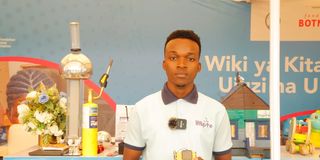
Innovative young man Jumbe Mbwana demonstrates a programme that automatically moves clothes from the rain to a dry place and returns them to the sun once the rain stops. PHOTO | MBONEA HERMAN

Tanga. While many people rush home to rescue clothes left outside when it starts raining, young innovator Jumbe Mbwana has developed a technology system that detects rainfall and automatically moves clothes to a dry area.

Mbwana is among young innovators participating in the Education, Skills and Innovation Exhibition in Tanga, which brings together young people from different areas to showcase their ideas and inventions.

Speaking at the exhibition, Mbwana said he developed the system after identifying a common problem faced by people who wash and hang clothes out to dry before leaving home for work or other activities.

“When it rains suddenly when no one is at home, the clothes get wet, causing inconvenience,” he said.

The system, known as Rain Detector, automatically detects rainfall and moves clothes from the drying area to a sheltered location.

Mbwana said it can also return the clothes to their original position once the rain stops, reducing the need for someone to be at home to move them.

“This programme can detect rain automatically and move the clothes to a place where they will not get wet. When the rain stops, the clothes return to where they were hanging. The aim is to solve a challenge people face in their daily lives,” he said.

However, Mbwana said the innovation needs investment and capital to move beyond exhibitions and be adopted on a wider scale.

He called on the government and other stakeholders to support young innovators so their ideas can be developed and used to address challenges facing communities.

Another young innovator, Abdul Kobelo, showcased a Car Parking System designed to reduce congestion in areas where parking demand is high.

Kobelo said the system could be used at hospitals, institutions and other facilities with high volumes of vehicles, allowing drivers to know whether parking spaces are available before entering.

“I developed this project to help reduce congestion. The system uses sensors to detect the availability of parking spaces. When an area is full, a red light comes on to show that there is no space and vehicles cannot enter,” he said.

He added that when parking space is available in another section, the system directs the driver there, allowing the vehicle to enter and park.

Kobelo said the innovation could help reduce traffic congestion but requires support to enable it to be developed and deployed in different areas.

He thanked Tanga Yetu through Project Inspire for supporting young innovators through the Vijana Bunifu programme.

Mohamed Mohamed, coordinator of the STEM Park Tanga Innovation Centre, said Vijana Bunifu was established to help children and young people turn knowledge acquired in science, technology, engineering and mathematics (STEM) into solutions to community challenges.

“After young people have been equipped with STEM knowledge and skills, the next step is to enable them to use that knowledge to develop projects that address challenges in their communities,” he said.

Hadija Idirisa, a programme assistant at Tanga Yetu, said the innovators had reached the stage of showcasing their work because of support provided through the programme.

She said the young innovators still needed broader support to improve their inventions, take them to implementation and benefit economically from their work.

“The main goal of this programme is to help young people move forward, whether in technology or economic activities, by supporting them in different ways.

We support them through education, funding and training so they can continue developing their ideas and achieve their goals,” she said.

The innovations showcased in Tanga demonstrate how young people are turning everyday challenges into potential technological solutions, while highlighting the need for greater investment to help move promising ideas from exhibitions into practical applications.