You are tired, having been out of town, where, with certain scribbling colleagues, you undertook some mentally draining tasks.
You’re now at your peripheral side of Dar City, having dropped off a daladala and headed straight to your inner locality, which is “blessed” with a whole four drinking joints, each with a quality of its own.
These are your drinking places of choice after sunset, since each of them is just a short walking distance to the place you call kwangu.
You prefer them because, even if you, in the unlikely event, degenerate into a drunken geezer, you could still stagger safely home.
A quick check-out makes you choose the bar with the least noise. You hate noise… very much so! Ageing has done its bit with your eardrums, and you don’t want to worsen that by being a customer in avoidable noisy environments.
That is why you walk to this one which, its lack of vibe notwithstanding, entertains drinkers with tolerable noise (sorry, music).
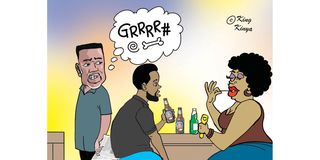
You notice there are just a few patrons occupying three of the seven tables that furnish this joint. The kitchen lady welcomes you and asks if you would like her to prepare for you some mishkaki, and you tell her, 'No, thank you.' You proceed to where the sole mhudumu for vinywaji is seated with a customer. Like her customer, she has a beer before her.
She says karibu, without bothering to stand up and suggest to you where you should sit.
You consider that basic because, even at home, you normally stand up to usher in your visitor and direct them to where they should sit, even when they’re little children who call you Babu.
She repeats, “Karibu…sit anywhere, mzee.” She says that while picking her teeth with her small finger’s nail. Or maybe she is eating her nails, as is common with many people these days even when they walk on the street. Kula kucha!
It amuses and disappoints you that she cannot realise you aren’t taking a seat because you want her to show courtesy first.
You’re a senior citizen, and you always feel obliged to see to it that our youth in Bongo conduct themselves in ways that will enable them to withstand foreign competition once the East African Community becomes an open job market to all and sundry from the region.
She even continues to drink, straight from her small bottle, as you remain standing, waiting for her to pick herself up, lead you to a table, make you sit down and ask you, “Unakunywa nini mzee wangu?”
It is clear that won’t happen, so you turn around and start walking out of the place. That is when the mhudumu stands up sharply and asks, “Mzee, how come you’re leaving…kwani, what beer should I serve you…please don’t go away…"
You ignore her and proceed to another bar that is some metres away. Here you head straight to the counter, where you get engrossed in the newspaper you are carrying as you enjoy your beer. You psych your brain to shut out the noise from huge speakers hanging above your head to the right.
You take your usual three warm ones, pay Rukia the akaunta and walk away without even saying goodbye to her because, even if you bothered to say kwaheri, she wouldn’t hear you.