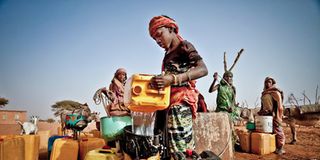
The world needs an Africa confident enough to name the wisdom in its traditions and honest enough to expose its corruption. PHOTO | AGENCY
By Dr Samuel Andema
The world’s present disorder is often described in the language of separate crises: war, climate change, inequality, loneliness, and political polarisation.
But these are not simply failures of diplomacy, economics, or technology. They also reveal a failure of relationship, a growing willingness to pursue security, wealth, and power while treating the lives of others as distant, negotiable, or disposable.
Africa has no monopoly on humane living, and it would be dishonest to present the continent as one harmonious village. We know ethnic violence, domestic abuse, corruption, and the exclusion of those who do not belong to the dominant tribe, party, or social group.
Yet, beneath these contradictions, many African societies retain a demanding moral idea that the contemporary world urgently needs: a person’s life is made possible by other people, and, therefore, carries obligations beyond the self.
I recognised this idea not from philosophy books, but from ordinary life. In the communities that formed me, bereavement is rarely left to the immediate household.
People arrive with firewood, food, chairs, money, and labour. Women organise the cooking; young men prepare the burial place; neighbours receive visitors; relatives travel through the night because absence at such a moment would be understood as a moral failure.
The family may be grieving, but it is not expected to grieve alone. The same ethic appears when relatives pool money for a child’s school fees, when a household takes in an orphaned niece or nephew, or when members of a village clear a road or repair a water source through communal labour.
The popular summary of Ubuntu, ‘I am because we are’, can sound sentimental. Properly understood, it is not. It asks uncomfortable questions of the successful professional who forgets the teachers and relatives who carried him; of the politician who invokes community during elections but abandons it once in office; and of the wealthy society whose comforts depend on labour and resources extracted from places it prefers not to see.
African relational thought restores that missing connection. It insists that the object in my hand is linked to somebody else’s labour, that my consumption may carry another person’s burden, and that prosperity cannot be judged only by what it delivers to the buyer.
This is also why the philosophy matters to climate change. A drought in Karamoja, flooding around Lake Victoria, or failed harvests in the Horn of Africa cannot be treated as unfortunate local events when the warming that intensifies them has been driven largely by consumption elsewhere.
Yet Africans should resist turning relationality into a flattering story about ourselves. Community can protect, but it can also suffocate.
The extended family that raises an orphan may pressure a woman to remain in a violent marriage.
A clan network that helps members find work may become nepotistic when public jobs are distributed as private favours.
Respect for elders may preserve memory, or it may shield leaders who have long ceased to serve.
Africa can contribute a different account of achievement: not the denial of individual excellence, but its placement within a wider moral debt. A degree, a public office, or a profitable business should enlarge one’s capacity to improve other lives.
Success that severs every obligation to the community that made it possible is not complete success.
The world does not need an idealised Africa. It needs an Africa confident enough to name the wisdom in its traditions and honest enough to expose its corruption.
At a time when nations, corporations, and individuals increasingly behave as though they can prosper behind walls, Africa can restate a truth learned in courtyards, village meetings, burial gatherings, and family councils: nobody becomes fully human alone.
The writer, Dr Samuel Andema, is an Assistant Professor at Aga Khan University`s Institute for Education Development, East Africa