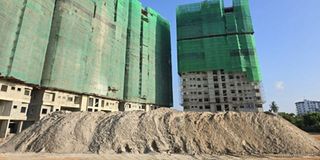
The Regional Commissioner (RC) for Dar es Salaam, which is by far the largest city in Tanzania, has of late been giving out a series of directives, one of which concerned development control, citing cases where a developer is given a building permit for putting up a seven-story building, but ends up putting up ten, or more; and that such developers should be punished. The RC’s stand has drawn support from the Ministry for Lands.
Development control is one of those tools of government intervention in land markets, to address market failures. Where development control is effective, both developers and consumers of real estate products operate in a conducive atmosphere. Where development control is weak, as is the situation in our urban areas, stakeholders face a situation of uncertainty which increases the risk of investing in real estate as well as that of enjoying real estate products such as housing or commercial properties.
One tool of development control is the issuance of a building permit by regulatory authorities, which are, in most cases, local authorities, but in other cases central government organs such as the Ministry of Lands.
When applying for a building permit, one is required to show the plans of what one is planning to put up, including structural features and location of the proposed development on the site.
Development control is needed to manage land use, ensure building and public safety, and prevent chaotic urban growth by making sure buildings and structural changes comply with established engineering, environmental, zoning and planning laws.
A typical building goes through a number of stages including: planning and design; site preparation, foundation work, structural construction, putting in services (electricity and plumbing), components and finishes, landscaping and getting an occupation permit.
After a building permit application is scrutinized and a permit given, the developer (even if he is building a single residential property) has to work hand in hand with building inspectors right from setting up the building, investigating soil properties, site clearance and levelling, marking the exact layout of the building, digging trenches for the foundation, pouring the concrete footing and building the base and letting the concrete dry and getting strong.
Throughout, including putting up other building stages, the developer has to be get a certificate, after finishing one stage, before continuing to the other stage. Thus, given this kind of supervision, there is no way how a developer, whose permit is for a seven-story building, can put up a 10-storey one.
Control is not just about building height but also about structural safety, including using the right building materials (cement, sand, reinforcements) and building processes for the kind of building and expected uses. Structural safety aims at ensuring the building does not collapse. We have witnessed buildings collapse, and leading to injuries and loss of life.
We will recall that in March 2013, 16-story residential building under construction gave way in the central business district, crashing onto a neighboring mosque compound and killing 34 to 36 people.
Nearly two years ago, in November 2024, a busy multi-story commercial building at Mchikichi and Kongo streets, in Kariakoo, collapsed during trading hours, killing 29 people and injuring over 80 others.
Development or building control is also about building setbacks. A building setback is the minimum required distance that a structure must be placed from a plot boundary, road, river, or other boundary. It creates an open, unbuilt buffer zone around a building.
The front setback sets the distance from the street or road facing the property; side setbacks are the distances from neighboring properties on the left and right; and rear set back is the distance from the back boundary line of the plot.
The purpose of setbacks, is, among others, to ensure clear access for emergency vehicles such as the police, ambulances and firefighters; to allow sunlight and ventilation to reach streets and adjacent properties; to leave room for underground pipes, power lines, and drainage; and, to keep buildings spaced apart from neighboring buildings.
This is an aspect of regulation that is completely ignored in many parts, including Kariakoo, where high rise buildings stand cheek by jowl. In many places also, roads are encroached upon, making them narrower as time goes by.
Another element of development control is plot ratio. Plot ratio is the mathematical relationship between a building’s total gross floor area (all indoor floors combined) and the total land area of the site. Also called Floor Area Ratio (FAR), it dictates how big or dense a building can be on a specific piece of land.
Thus, concern about unauthorized high story buildings is genuine, but it is important to note that there are other aspects of development control.
Development regulation authorities, be they local governments or the Ministry of Lands, need really to come up strong in enforcing and supervising building regulations for the protection of developers, users of buildings, and the general public.
Lusugga Kironde is Professor of Land and Urban Economics and lead consultant at TKA Company Ltd.