How Africa can restore its forests, which are disappearing at an alarming rate
By Wanjira Mathai
Data from Global Forest Watch, the world’s most trusted platform for real-time forest monitoring, has revealed that global tree cover loss in 2025 was 25.5 million hectares—an area roughly the size of Ghana lost in a single year.
While this is a decline from 2024’s catastrophic record, fires remain the primary driver of loss, burning more than twice as much tree cover as they did two decades ago.
Furthermore, climate change is threatening forests inside and outside the tropics, with extreme heat and drought fuelling bigger, more damaging fires.
And perhaps most sobering of all: one third of all global forest lost between 2001 and 2024 is likely permanent. Sadly, Africa’s forests, particularly the all-important rainforests of the Congo Basin, are not spared.
Unlike Latin America and Southeast Asia, where industrial demand for cattle, soy, and palm oil drives destruction, Central Africa’s forest-loss is due to the daily struggle to survive. Hunger, fuel-wood, and food for growing families are consuming forests that the world cannot afford to lose.
Nowhere is this more visible than in the DR Congo home to the world’s second-largest tropical primary forest, yet one where 86 per cent of forest loss was from small-scale farming, charcoal harvesting, and the desperate movements of communities displaced by armed conflict.
Forest loss
Though DRC’s primary forest loss dipped 5 per cent last year, non-fire loss hit a record high, a warning hidden within apparent progress. Across the Basin, Cameroon tells an even starker story, with primary forest loss rising 10 per cent to its highest level ever recorded, driven by cocoa expansion and conflict-driven displacement.
And yet against this backdrop, there is still good news. The Republic of Congo and Gabon, both considered “High Forest Low Deforestation” countries, held their ground last year even after a difficult year of fire-related loss.
As the latest GFW data landed, Kenya welcomed a high-level delegation from the government of China and the World Bank Group-China Centre for Ecological Systems and Transitions.
Gathering at the annual Global Landscapes Forum banner to restore landscapes at a scale that actually matches the crisis.
The moment marked the launch of the Living Landscapes Academy and the beginning of a transformative alliance with Kenya, Rwanda, Ethiopia, Zambia, and Malawi.
At the heart of it all is the urgent reality that restoration must scale to meet the demand for landscape repair.
China has already proven it is possible: One in every four trees planted on Earth today is planted in China. Yes! That’s the scale.
The Living Landscapes Academy now seeks to partner with African restoration champions to inspire ambitious scaling. This partnership holds genuine promise, but promise alone is not enough. I believe the success of this effort will not be determined by the ambition of its design or the prestige of its partners.
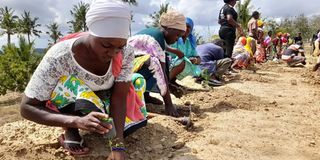
Africa’s restoration journey has already proven that it is possible to simultaneously restore degraded land, create green jobs, connect farmers to markets, and align ecological health with economic opportunity.
The lessons learnt through years of standing with communities demonstrate clearly that when communities lead and partners support meaningfully, landscapes can recover and thrive. In my opinion, three shifts must define this next chapter.
The first is a policy shift. China’s restoration success emerged from decades of policy alignment and long-term planning that refused to bend to short-term pressures.
Africa’s task is not to copy that story, but to learn from it, adapt it, and make it our own. Through programs like the Landscape Policy Accelerator, partners can help African governments translate those lessons to fit their landscapes and communities. Policy is the glue that holds ambition together, and the signal that tells the private sector investment is safe.
Nursery management systems
The second is a knowledge shift. African universities, TVETs, and research colleges must be at the centre of this work as innovators generating locally grounded research, training the next generation of restoration scientists, and anchoring institutional memory on the continent.
The sector must also embrace smarter logistics, nursery management systems, and technologies that reduce the cost of seedling production at scale. That learning must flow in both directions, China-Africa, honestly and with genuine curiosity.
The third is a mindset shift. The most dangerous obstacle to scaling restoration is not capital or political will, but what Michael Gerson called the “tyranny of low expectations”. That damaging habit of underestimating communities, which blinds us to the extraordinary knowledge and brilliance embedded in everyday life.
As we confront the loss of millions of hectares of forest each year, let us remember that Mother Nature, always patient, resilient, and life-giving, is watching to see whether we will finally rise to meet her.
Wanjira Mathai is MD for Africa & Global Partnerships at the World Resources Institute