Improved Ocean Road centre set to receive more ‘international’ patients
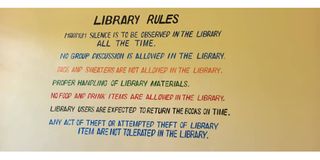
A reader saw this notice posted on the wall of a school library. We agree that, besides the numerous linguistic challenges, the repetitive use of the word LIBRARY should have been avoided. Our suggestion is: Library materials must be handled with care/Borrowed books must be returned on time/Theft of library materials will not be tolerated. Trust signwriters! PHOTO | COURTESY
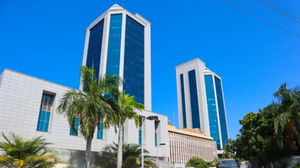
When an individual from outside our national borders comes to our internationally recognised cancer treatment hospital—the Ocean Road Cancer Institute (ORCI)—this person is a FOREIGN patient. Why, the word foreign basically means “from another country”.
Bongo’s huge and colourful broadsheet of Wednesday, January 7, has a story on Page 1, entitled, ‘Minister: Treat all cancer cases locally, referrals abroad must end.’
In Para 3, the scribbler writes: “Advanced diagnostic equipment such as a PET-CT scanner and installing a cyclotron for nuclear medicine production, tied to a new international service building also under construction to improve care for local and INTERNATIONAL patients.”
The sentence is incomplete (has no predicate), but that’s besides our concern here.
Our concern here is that we view the adjective “international” to define somebody who comes to Bongo for medical treatment as superfluous. Our wordbook tells us that “international” implies cooperation or connection between nations.
When an individual from outside our national borders comes to our internationally recognised cancer treatment hospital—the Ocean Road Cancer Institute (ORCI)—this person is a FOREIGN patient. Why, the word foreign basically means “from another country”.
In Para 7, the scribbler writes in connection with what a senior medic said: “He asserted this (sic!) would position ORCI among the highest capacity cancer centres in Africa and thus boost its potential for care visitations (sic!) FROM other countries’ TOURISM.”
Care visitations from other countries’ tourism? This doesn’t make sense to us, and we aver the scribbler meant to simply say, “Care visit from other countries.”
Our colleague goes on to report (in his own words) what the medic purportedly said: “Real transformation goes beyond infrastructure and machinery BUT demands innovative service delivery across the entire patient (sic!) journey…”
Here we’re noting a case of inappropriate use of the conjunction “but,” the way Kiswahili’s “lakini” is being abused left, right and centre by virtually everybody including, sadly, members of Fourth Estate who should know better!
The conjunction “but”, just like “lakini” in Kiswahili, should only be used to introduce a phrase or clause CONTRASTING with what has already been mentioned.
Page 3 has a photo whose caption reads: “A small trader in meditative mood insider a commuter bus plying the Mwenge-Kimara Mbezi ROUTES in Dar es Salaam…Hello! The Mwenge-Kimara Mbezi is a ROUTE (one), not routes.
Page 3 of the Friday, January 9 edition the tabloid closely associated with this columnist has photo that adds colour to a story entitled ‘Samia tasks marine scholars to drive blue economy agenda.’
For a caption, this is what’s written: “President Samia Suluhu Hassan (CENTRE) marks a milestone for the blue economy by cutting the ribbon on new facilities at the Institute of Marine Sciences in Zanzibar.”
Hang on! Anything goofy here? Yes, sort of, because this being a national daily, we don’t need to point out where in the photo our nation’s Head of State is located. Etiquette, we call it. Or protocol, if you like.
On Page 5 there’s another story, entitled ‘China’s foreign minister starts two-day VISITS in Tanzania.’ Hello! The Chinese foreign minister on two-day visits…? Nope! He’s on a two-day VISIT. Even if minister Wang Yi were to stay for 10 days after landing in Bongo on January 9, his would still be described as a visit—a ten-day visit.
In the last Para, the scribbler writes in reference to what our foreign ministry said about the historical relations between TZ and China.
“It recalled that the strong ties between the two nations were laid by their founding leaders, the LATE Mwalimu Julius Nyerere and the LATE Chairman Mao Zedong…”
Just a minute, our scribbling brother! Historical figures such as Chairman Mao Zedong (1989 – 1976) or Mwalimu Julius Nyerere (1922 – 1997) “do not die” even after passing on. For that reason, etiquette demands that we refrain from prefixing their names with “the late” tag.
Which is why you might come across a presenter saying: “Mwalimu Nyerere, in his 1968 book, Ujamaa: Essays on Socialism, SAYS… (not said…).
Ah, this treacherous language called English!
Send your photos and linguistic gems to email [email protected] or WhatsApp on Tel No 0688315580