There are two types of cardio in Tanzania. The first one is voluntary, jogging, gym, pretending you’ll start on Monday. The second one is crossing the road.
You stand at a zebra crossing. You look left, right, left, right, left, right then left again.
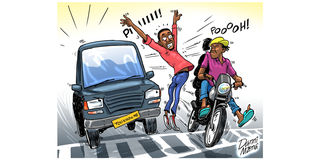
A car is coming. It does not slow down. The next one swerves slightly, just enough to suggest, I see you… but I also have places to be.
A boda boda slices between lanes like it’s auditioning for an action movie. You step back onto the kerb and laugh nervously, because what else can you do?
By the time you finally cross, you haven’t just reached the other side of the road. You’ve survived a small life event.
Zebra crossings were meant to be a simple social contract...here, the human being wins.
But on many of our roads, those white stripes are more of a suggestion than a rule, decorative road art with ambitious goals.
If patience were a sport, Tanzanian pedestrians would bring home gold medals.
Watch any busy crossing in Dar or any of the big cities.
People gather at the edge like they’re waiting for a bus that never comes.
A mother grips her child’s hand tighter with every passing second. A student with headphones around their neck pretends not to be scared. An older man studies the traffic like he’s solving advanced mathematics.
Everyone is waiting for that rare miracle... a driver who actually stops.
And when it happens? Confusion. Suspicion. Eye contact to confirm, Are you sure? Or is this a trick?
We have reached a point where basic road courtesy feels like a generous favour.
Apart from the crossing drama even begins, there’s the small issue of where pedestrians are supposed to walk in the first place.
In many areas, sidewalks are cracked, narrow, or mysteriously end mid-journey as if the planner simply got tired.
Other areas, are occupied by parked cars. Others have been adopted by small businesses trying to survive.
Motorcycles treat them as express lanes. Add a few open drainage trenches and suddenly the safest place to walk feels like… the road.
In theory, they should be calmer spaces. In reality, they’ve become parking lots, shortcut routes, and unofficial terminals.
Cars park there. Others speed through to overtake traffic. Bajajis line up waiting for passengers.
Bodabodas weave through like they’re in a video game.
The message to anyone on foot is that this space is also not for you.
At this point, you start to wonder if city planners believe pedestrians have special powers.
Maybe we’re expected to teleport from one building to another. Or grow wings. Or simply float politely above traffic until it clears.
Because clearly, the very basic act of walking, placing one foot in front of the other on solid ground, was not fully considered.
We talk a lot about improving transport, but mostly for vehicles. Meanwhile, the oldest form of movement, using your legs, has been downgraded to a risky hobby.
That unspoken hierarchy. At the top, cars. Then buses. Then motorcycles. Somewhere near the bottom, just above stray goats, are pedestrians.
Honking at someone already halfway across the zebra crossing has become normal.
Drivers inch forward to “encourage” faster crossing, as if the pedestrian is delaying a national emergency.
Motorcyclists zigzag through any gap that looks wider than a school ruler.
Speed is treated like a right. Slowing down is treated like a personal sacrifice.
But roads are public spaces, not racetracks. And in any public space, the most vulnerable people should be the most protected, not the most stressed.
Not everyone can afford a car. Many people walk to daladala stops, to markets, to work, and to school. Children cross busy roads in uniforms two sizes too big. Elderly people, who cannot run even if they wanted to, stand stranded on road medians like forgotten luggage.
Pregnant women and people with disabilities navigate potholes, traffic, and missing pavements with quiet determination.
Meanwhile, those inside vehicles are shielded by metal, glass, and airbags, barely noticing the daily obstacle course outside.
Mobility should be a basic right in a city. Instead, safety often comes down to whether or not you have an engine.
Yes, the law says drivers must give way to pedestrians at zebra crossings. But laws that are not enforced slowly fade into folklore.
Drivers get stopped for documents, licences, and compliance stickers, all important. But how often do we see someone penalised for flying past a zebra crossing while people wait helplessly at the side?
If breaking the rule has no consequence, then the rule quietly retires.
What we have now is not a system. It’s a gamble. The frustrating part? None of this requires magic.
Raised zebra crossings that force cars to slow down. Clear, protected sidewalks. Working pedestrian lights in busy areas. Serious enforcement near schools and markets.
These are not luxury ideas for futuristic cities. They are basic signs of a society that values human life over arrival times.
A zebra crossing should mean certainty. You step forward, cars stop. Simple. Predictable. Safe.
Right now, for many Tanzanians, it means hesitation. Eye contact. Calculations. A quick prayer.
A truly modern city is not measured by how fast cars can move but by how safely a child can cross the street.