Thirty projects, one promise: A Decade of Water that Reshaped Rural Tanzania
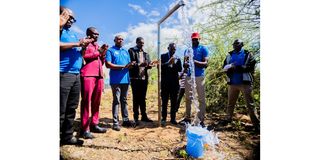
Government leaders led by the Deputy Minister for Water, Hon Eng. Kundo Mathew (third right), and Managing Director of Serengeti Breweries Limited, Dr Obinna Anyalebechi (second right), witness the official commissioning of water project funded by SBL. The event took place in Baray, Karatu District, Arusha.
What a decade of community water investment by Serengeti Breweries Limited has taught Tanzania about the partnership between business and the country it serves.
In a quiet corner of Karatu District in Arusha Region, on the morning of 30th April 2026, water flowed for the first time through the new pipes of Baray.
For more than 15,000 men, women and children who call that village home, the day marked the end of long walks in search for the liquid that is called life - Water.
For Serengeti Breweries Limited (SBL), it marked something else: the completion of its 30th community water project in Tanzania, a milestone that the organization marks with pride.
Thirty projects. Eleven regions. Over 2.3 million Tanzanians reached. More than two billion shillings invested. And more than one hundred women trained, empowered, and placed at the centre of how water is governed in their own communities through a unique Water Sanitation & Hygiene (WASH) empowerment programme, for women in the recipient communities, that was run concurrently with the water projects.
These are the headline numbers of a decade of work. But behind every number is a village, a woman, a girl, a farmer - and a story of what becomes possible when clean water comes closer to home.
SBL makes beverages, and uses water as one of the key ingredients. . A decade ago, the company set itself a stretching target that it would replenish, in equal measure, every litre of water used for the production of its beverages.
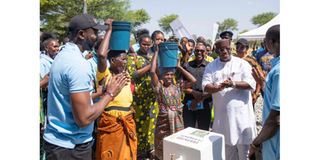
Mwanza Regional Commissioner, Hon. Said Mtanda (second right) and Managing Director of Serengeti Breweries Limited, Dr Obinna Anyalebechi (left), together with community members, celebrat after the handover of the major Kabila Water Project in Mwanza Region.
The enabler to achieving the targets became the Preserve Water for Life program - SBL's commitment, launched in 2016, to replenish every drop withdrawn by its sites in water-stressed areas, and to do so in the rural communities where the burden of water scarcity falls hardest.
That burden, it turns out, is not borne equally. According to the 2026 United Nations Tanzania Gender Snapshot, women and girls aged 15 and above collect water in 79 per cent of households without water on site, compared with just 11 per cent for men and boys.
Nearly 94 per cent of women experience the effects of water scarcity directly, because of their central role in household care and food preparation. The numbers are striking, but the lived reality is more striking still: long walks before dawn, missed school days, lost economic hours, and quiet sacrifices repeated across generations.
In Kwadelo, Dodoma, SBL's team met Mwanahamisi Ally, a woman who once walked long distances before sunrise in search of water. "Before, we used to walk long distances to fetch water, and it was very dangerous," she recalls. "I was once attacked by a hyena during those journeys, and I am thankful to be alive.
But after the water project was brought to Kwadelo, many of us, as women, have avoided those dangers. Now the water is close, and life has changed." Her story is one of thousands the company has heard across this country - and it has shaped everything that has followed.
From the peaks of Kilimanjaro to the shores of Pwani, from the highlands of Ruvuma to the flatlands of Simiyu, SBL has worked alongside the Government through RUWASA, and local communities to build water systems that serve and endure. In Kabila Village in Magu District, the company's project now provides clean water to over 11,000 residents and has integrated women into the water committees at 50 per cent representation.
In Handeni, 24 women trained through the programme have gained skills in soap-making, kitchen gardening, tree planting and beekeeping. In Kondoa, in Karatu, in Ihushi, in Kambi ya Simba and now in Baray - the pattern has held: clean water, community ownership, women empowerment and economical enhancement and growth.
Speaking at the Baray handover, SBL's Managing Director, Dr. Obinna Anyalebechi, reflected on the meaning of the milestone. "Thirty water projects is not just a number," he said. "It is thirty communities where children no longer walk kilometres for water, where mothers have time to build businesses, where clinics can treat patients safely. We are a Tanzanian business, and our success is measured by the country we help to build."
Speaking at the same ceremony, the Deputy Minister for Water, Hon. Eng. Kundo Andrea Mathew (MP), who represented the Minister for Water, Hon. Juma Aweso, commended SBL's contribution to Tanzania's national water agenda. "The Government continues to ensure that every citizen has access to clean and safe water, but these efforts require collaboration from various stakeholders," he said. "We highly appreciate the contribution of the private sector, such as Serengeti Breweries Limited - in helping us deliver on the promise this Government has made to the people of Tanzania."
The company has learned that infrastructure alone is not enough. A borehole that the community does not own is a borehole that does not last. That is why every SBL water project is built in deliberate alignment with Tanzania's National Water Policy, which places community participation at the very heart of sustainable water provision.
The projects are designed, built and handed over to community-based water supply organisations that will steward them for generations. The pipelines belong to the people who draw water from them.
The company has also learned something more fundamental: when you give a woman back her time, she builds the world. Across SBL's Water programmes, more than one hundred women have been trained as champions of water governance, entrepreneurship, financial literacy and leadership. They are running businesses. Sit at water projects committees.
Educate their children and are also reshaping the rhythm of life in their villages. Inclusive water projects do not simply deliver litres. They return hours to women. They keep girls in school. They reduce risks of violence. They build confidence, leadership, and stronger livelihoods.
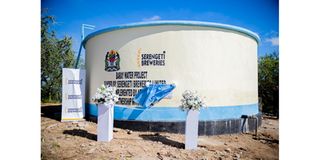
Baray Water Project is the one of the major water projects funded by Serengeti Breweries Limited in Karatu District, Arusha Region.
SBL is proud to be one of Tanzania's largest taxpayers. But the company's contribution to this country is never going to be measured by the tax ledger alone. It is measured in the boreholes it has drilled, the farmers it sources from, the Tanzanians it employs, and the communities it stands alongside. "Our responsibility to Tanzania rests on three pillars," Dr. Anyalebechi has said. "The taxes we pay, the jobs we create, and the communities we invest in. A sustainable, growing business is what enables all three."
Ten years on, the story of water has become bigger than water. It is a story about time. About dignity. About the safety of a young girl walking to school instead of to a riverbed. About the quiet power of women shaping a better future for their communities, alongside their male counterparts, and their country.
Thirty projects. Ten years. One unbroken promise kept. And a Tanzania, a drop at a time, becoming whole.