Zanzibar goes green with launch of electric bus network
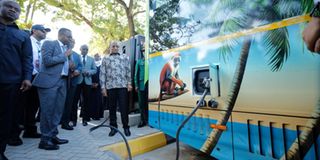
Zanzibar President, Dr Hussein Ali Mwinyi, observes how electric buses are charged at the newly inaugurated Malindi bus terminal in Urban West Region during the official launch of the island's modern public transport service on Thursday, July 23, 2026. PHOTO | JESSE MIKOFU
Unguja. Zanzibar has officially launched electric public transport, with President Hussein Ali Mwinyi outlining a target to transition the entire island's vehicle fleet to electric power to safeguard the environment.
Executed by the Zanzibar Social Security Fund (ZSSF) in partnership with India’s GRT, the project will eventually deploy 500 buses.
A fleet of 15 buses has commenced operations in the first phase, with others awaiting the completion of supporting infrastructure.
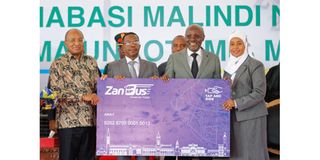
Passengers will pay fares using smart cards categorised into three tiers: dark blue regular cards (Sh700), gold student cards (Sh350), and black senior citizen cards for those aged 70 and above (Sh350).
Speaking at the launch event and the inauguration of the Malindi terminal in Urban West Region on Thursday, July 23, 2026, Dr Mwinyi emphasised that the fleet represents the first phase of a broader clean-energy transition.
“We have started with these 15 buses, but the goal is 500. Once we complete public transport, we will move to government vehicles, and ultimately to private cars. We want all of Zanzibar to use electric vehicles,” said Dr Mwinyi.
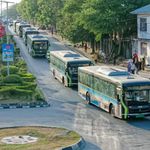
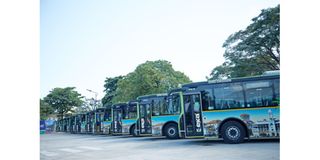
A section of the newly launched fleet of electric buses parked at the Malindi bus terminal in the Urban West Region in Zanzibar, awaiting deployment to serve commuters across the island's urban routes as pictured on Thursday, July 23, 2026. PHOTO | JESSE MIKOFU
Responding to political critics, the President stated that despite opposition scepticism, the administration remains committed to delivering its promises.
“Often when I speak at rallies, political rivals mock our targets. But today we are delivering on what we promised,” he said.
Under the new transport system, regional buses from outside the urban zone will terminate at perimeter hubs, where electric buses will pick up passengers for inner-city travel.
Dr Mwinyi urged ZSSF to expedite the construction of remaining terminals to ensure project timelines are met.
He added that the discounted fares and designated system would improve travel conditions for students.
Addressing recent claims regarding the cost of the key Afcon stadium project, Dr Mwinyi refuted allegations that the government spent Sh1.4 trillion.
He clarified that the actual cost is $150 million (over Sh300 billion).
The claims were raised recently by ACT-Wazalendo Party Leader, Mr Othman Masoud Othman, during a media interview.
Zanzibar President, Dr Hussein Ali Mwinyi, receives a mock-up of the smart card to be used by passengers on the newly launched electric buses, shortly after inaugurating the service at the Malindi bus terminal in Urban West Region on Thursday, July 23, 2026. PHOTO | JESSE MIKOFU
Dr Mwinyi explained that the facility forms part of a broader sports tourism strategy, featuring an Olympic-sized swimming pool, training pitches, commercial developments, hotels, and residential units.
“We are building a modern sports city, not just a stadium. This investment will expand sports tourism and increase visitor arrivals,” he said.
ZSSF managing director, Mr Nassor Shaaban Ameir, noted that bus doors will be driver-controlled for safety.
He added that construction will soon begin on additional terminals in Mwera, Jumbi, and Mnazimmoja, with 35 more buses ready for deployment once infrastructure is complete.
Minister for Finance and Planning, Dr Juma Malik Akili, noted that the joint venture between ZSSF and GRT will boost the transport sector, which currently contributes 50 percent to Zanzibar's economy.
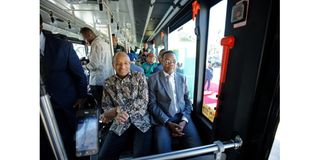
Zanzibar President, Dr Hussein Ali Mwinyi, sits inside one of the newly launched electric buses during the official inauguration ceremony at the Malindi Bus Terminal in Unguja, Zanzibar on Thursday, July 23, 2026. PHOTO | JESSE MIKOFU ENDS
Second Vice President, Mr Hemed Suleiman Abdulla, added that the project will reduce traffic congestion, lower noise pollution, and digitise public transport.
Minister for Infrastructure, Communication and Transport, Dr Khalid Mohamed Salum, described the launch as a historic milestone for East Africa.
Residents welcomed the launch, though some raised questions regarding smart card usage.
A resident of Kiembesamaki, Ms Khadija Saleh Haji, expressed optimism: “It is positive to see modern transport here. We used to admire these systems elsewhere, but now we have them in Zanzibar.”
Register to begin your journey to our premium contentSubscribe for full access to premium content