Zanzibar moves to boost agriculture, livestock production and cut food imports
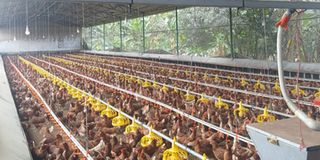
Some of the layer chickens at Zanbreed Poultry Farm in Mbuzini, North Unguja Region, during ministers’ visit on Tuesday, July 21, 2026. PHOTO | JESSE MIKOFU
Unguja. Zanzibar has begun creating an enabling environment to boost agriculture and livestock production, intending to achieve food self-sufficiency and reduce dependence on imports.
With more than 600 tourist hotels on the islands, demand for chicken meat, vegetables, fruits, and spices remains high, but about 70 percent of these products were previously imported.
To address the challenge, the government has started establishing a favourable environment for agricultural and livestock investments by both local and foreign investors, with the expectation of attaining self-sufficiency within a short period.
Speaking after sector ministers visited farmers and livestock keepers on Tuesday, July 21, 2026, the Minister for Agriculture, Irrigation, Natural Resources and Livestock, Mr Suleiman Masoud Makame, said the plan aims to address challenges facing farmers and livestock keepers to boost production.
“Following our tour and the strategies we expect to implement, we are going to significantly reduce, or eliminate, the importation of products, especially eggs, chicken and vegetables. We will submit this report to the Revolutionary Council,” said Mr Makame.
During the tour, ministers responsible for Finance, Coordination, President’s Office, State House, and Lands visited a chicken production project and factory owned by a Türkiye investor, which will produce chicken meat and eggs.
The investor, Zanbreed General Manager Emin Saat, said production at the farm, which is expected to begin in August, will initially have the capacity to produce one million chickens per month.
“At that capacity, I will do half-and-half; 50 percent will be frozen and 50 percent sold fresh. This is because many Zanzibaris prefer frozen chicken, but gradually I will encourage them to prefer fresh chicken because we will have the capacity,” he said.
The farm, located in Kitope, North Unguja Region, will also have the capacity to produce 12,000 tonnes of animal feed.
Mr Saat said the farm has eight poultry houses, each capable of producing 80,000 chicks, giving a total capacity of about 650,000 chicks.
However, he identified electricity supply as the main challenge requiring a permanent solution.
Minister Makame said the project would significantly reduce imports of frozen chicken and eventually increase the supply of fresh chicken.
“They will significantly reduce imports of frozen chicken. They told us they will supply fresh chicken, meaning chicken that is not frozen,” he said.
The minister said the government would explore ways of addressing the challenges facing investors to create favourable production conditions, noting that the project would also create employment opportunities for young people.
Push for modern farming
The Minister of State in the Second Vice President’s Office responsible for Policy, Coordination and House of Representatives, Mr Hamza Hassan Juma, said Zanzibar had previously relied on small-scale poultry keeping, including groups of about 20 people raising 100 chickens.
“Therefore, we did not see real productivity among farmers. But today we have witnessed significant transformation after the Ministry of Agriculture encouraged farmers to adopt modern livestock keeping and productive farming methods,” he said.
He said Zanzibar currently imports chicken despite having more than 400 tourist hotels, adding that the high demand from the tourism sector presents an opportunity for local producers.
“Whenever a ship arrives, there are containers of chicken. Now we are going to end that,” he said.
Chief Extension Officer Salim Rehani said imports of vegetables and fruits had declined by 80 percent due to government efforts to encourage farmers.
However, he said onions and potatoes remain the only crops currently imported into Zanzibar at 100 percent, adding that efforts were underway to eliminate the remaining imports.
“There will be a significant increase in vegetable and fruit production, which will greatly reduce imports, particularly of crops such as tomatoes, peppers, watermelons, pumpkins and others produced in large quantities,” he said.
According to the Ministry of Agriculture’s 2026/27 budget speech, egg production increased from 22,089,658 eggs (736,321.9 trays) in 2024 to 29,861,934 eggs (995,397.8 trays) in 2025.
The number of slaughtered chickens also increased to 1,472,903 in 2025 from 1,085,856 in 2024.
Register to begin your journey to our premium contentSubscribe for full access to premium content