Zanzibar strengthens efforts to protect ocean resources
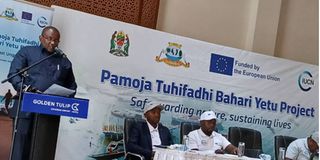
Pemba Officer-in-Charge of the Ministry of Blue Economy and Fisheries, Dr Salim Mohamed Hamza, speaks during the launch of a stakeholders’ platform for the north-eastern marine area of Unguja, Zanzibar on Thursday, July 16, 2026. PHOTO | JESSE MIKOFU
Unguja. A stakeholders’ platform has been launched for the north-eastern marine area of Unguja Island to coordinate and oversee the development of sustainable ocean activities after challenges and opportunities facing the marine sector were identified.
The challenges include mangrove destruction, water pollution, the impacts of climate change, and limited community participation in conservation decision-making.
The platform will also focus on opportunities in sustainable fishing, ocean literacy, investment, research, youth employment, and broader coastal community development.
It has been established under the Pamoja Tuhifadhi Bahari Yetu (Together, Let Us Conserve Our Ocean) project, funded by the European Union and implemented by the International Union for Conservation of Nature (IUCN) for €11.4 million (Sh33.34 billion).
Speaking on Thursday, July 16, 2026, during the launch of the platform in Unguja, Deputy Permanent Secretary in the Ministry of Blue Economy and Fisheries, Mr Zahro Kassim Al-Harous, said the initiative had come at the right time.
His speech was read on his behalf by Pemba Officer-in-Charge, Dr Salim Mohamed Hamza.
“This platform has come at the right time. It is evidence that we are strengthening these efforts by combining our strengths, knowledge, and resources through a unified system of cooperation,” she said.
Mr Al-Harous said the platform would improve coordination, strengthen communication between the government and stakeholders, promote experience sharing, and ensure decisions consider citizens’ interests, development, the blue economy, and environmental conservation.
The platform has been established based on principles of inclusion and accountability, with a main committee, secretariat, executive committee, and technical committees.
He said the initiative would help create a strong marine resource management system that balances the interests of natural resources, the environment, and communities.
“The vision of the blue economy is to see Zanzibar’s ocean continue to be a source of prosperity for citizens. We are implementing these activities in partnership with the Great Global Initiative, whose goal is to ensure that by 2030 at least 30 percent of marine areas are conserved,” he said.
Project Coordinator, Dr Igulu Mathias, said the initiative seeks to promote marine resource conservation, coastal forest protection, sustainable use of plastic products, and improved research and data collection.
He said the project aims to support the development of effective policies to manage the value chain of plastic products while working with research institutions and conservation organisations to strengthen management capacity.
The four-year project, running from 2024 to 2028, has a budget of €11.4 million (about Sh33.34 billion).
Zanzibar Department of Marine Conservation Director, Dr Makame Omar Makame, said the platform was established based on a shared understanding that marine and coastal resources are key to the livelihoods and development of Zanzibar’s people.
“Our ocean provides employment, but it also provides food, income, and various economic, social, and geological opportunities,” he said.Dr Makame said coastal marine ecosystems play an important role in conserving biodiversity, protecting beaches from climate change impacts, and ensuring the availability of vital ecological services for present and future generations.
Seaweed farmer from Kidoti, Ms Rukia Haji Juma, said communities benefit from the ocean as it provides income to support livelihoods while teaching them the importance of environmental conservation