Zanzibar targets deep-sea vessels, oil and gas projects in Sh209bn budget
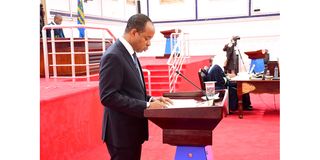
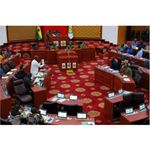
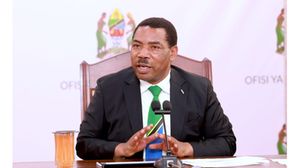
Zanzibar’s Minister for Blue Economy and Fisheries, Mr Masoud Ali Mohamed, presents the ministry’s 2026/27 revenue and expenditure estimates during the 11th session of the House of Representatives in Chukwani, Unguja, Zanzibar on Saturday, May 30, 2026. PHOTO| JESSE MIKOFU.
Unguja. The Ministry of Blue Economy and Fisheries has outlined four key priorities for the 2026/27 financial year, including the acquisition of large deep-sea fishing vessels, construction of fish processing plants, and expansion of marine resource infrastructure.
The ministry also plans to establish the Fungurefu Blue Economy Free Investment Zone and strengthen the oil and natural gas sector through 2D and 3D seismic surveys, alongside construction of a permanent National Data Repository (NDR) for petroleum information.
Presenting the ministry’s budget estimates in the 11th session of the House of Representatives in Chukwani, Unguja, on Saturday, May 30, 2026, Minister for Blue Economy and Fisheries, Mr Masoud Ali Mohamed, sought approval of Sh209 billion to implement the priorities.
“To strengthen deep-sea fishing, the government is in the final stages of acquiring large fishing vessels to enable access to deeper waters and increase catches,” he said.
He said two deep-sea fishing vessels will be procured as part of efforts to boost fish production and maximise returns from Zanzibar’s marine resources.
Mr Mohamed added that the ministry will continue promoting small-scale fisheries through construction of modern landing sites and markets, establishment of a laboratory to certify marine products for domestic and export markets, and expansion of cage fish farming.
On seaweed farming, he said the government will prioritise value addition through establishment of both small- and large-scale processing plants.
He said support for seaweed farmers will continue through provision of inputs and technical training aimed at improving productivity and quality.
The ministry also intends to strengthen the oil and gas sector through seismic surveys and establishment of a permanent data repository to improve management and accessibility of exploration data.
Committee recommendations
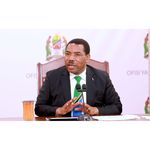
Presenting the Economy and Investment Committee’s views, the chairman, Mr Makame Mohamed Sufiani, urged increased investment in fisheries research, saying the sector requires substantial resources to unlock its potential.
He said the committee noted that existing research activities face financial constraints that limit effectiveness.
“The committee advises the ministry to develop sustainable infrastructure for accessing fish resources, as current facilities do not adequately meet blue economy market demands,” he said.
The committee also recommended amendments to fisheries legislation to address challenges hindering growth and investment.
On oil and gas, it called for measures to address funding gaps in monitoring activities and shortages of specialised personnel.
Members weigh in
Mkwajuni Representative, Mr Sulubu Kidongo Amour, CCM, called for stronger protection of marine resources, citing their importance to Zanzibar’s economy.
He said some boats distributed to fishermen under government programmes were being used for tourism instead of fishing, contrary to their intended purpose.
Women Representative, Ms Moza Mohamed Khamis, ACT-Wazalendo, said effective use of blue economy opportunities could reduce unemployment and improve livelihoods, particularly among youth.
Gando Representative, Mr Said Ali Mbarouk, urged a review of policy implementation, saying the sector remains underfunded despite its economic contribution.
“In the 2025/26 budget, Sh174 billion was allocated, but by March only Sh20 billion had been released, equivalent to 25 percent. This shows serious challenges,” he said.
He added that development projects could not yield meaningful results when only a fraction of approved funds is disbursed.
Women Representative, Ms Fatma Ramadhan Mandoba, called for greater focus on industrial development, saying processing industries could create large-scale employment for young people.
She noted that although fish production reportedly rose from 74 tonnes in 2024 to 79 tonnes in 2025, Zanzibar still imports significant quantities of fish.
“In this budget, it is not clear how women have been incorporated. Women are making a major contribution and should be fully supported in productive activities,” she said.
Pandani Representative, Mr Omar Fakih Hamad, ACT-Wazalendo, questioned continued allocations for oil and gas exploration without clear disclosure of results.
“Last year we approved Sh9 billion for exploration, yet we have not been told what was achieved. Now we are asked to approve Sh35 billion for the same work. What exactly is this money doing?” he asked.