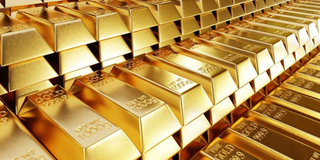
Dar es Salaam. A sharp retreat in global gold prices has raised concerns over its potential implications for Tanzania's export earnings, foreign exchange inflows and mining sector revenues, despite the precious metal remaining one of the country's most important sources of foreign currency.
Gold is Tanzania’s leading foreign exchange earner, generating $5.269 billion in the year ending April 2026, up from $3.821 billion in the year ending April 2025.
According to the Bank of Tanzania (BoT), the country’s official monetary gold reserves stand at 27.5 tonnes, valued at more than $3 billion.
The central bank actively purchases locally mined gold to diversify its foreign exchange reserves and, at times, sells portions strategically to lock in profits and inject US dollar liquidity into the market.
Gold prices had previously risen to as high as $5,500 per ounce last year, but have since reversed, prompting the BoT to reconsider plans to sell part of its reserves.
The downward trend has continued, with global gold prices falling by nearly 10 percent in less than a month. Spot gold traded at $4,088.97 per troy ounce on June 24, 2026, according to Reuters, down from $4,543.87 on May 30.
The decline follows a strong rally earlier this year, driven by global economic uncertainty, geopolitical tensions, and increased central bank purchases of safe-haven assets.
Despite the recent pullback, gold prices remain elevated by historical standards.
Market data show the metal traded at $4,321.48 per ounce on January 1, 2026, before rising to record levels in May, then easing in June.
While prices remain high, analysts warn that a sustained decline could weigh on export revenues and incomes across the gold value chain.
BoT Governor Emmanuel Tutuba said gold prices are determined by global supply and demand dynamics.
“The market value of gold depends on supply and demand. Currently, some countries, including Ghana, are selling gold, which has increased supply in the global market,” he told Business Daily on Wednesday.
Mr Tutuba added that despite geopolitical tensions in the Middle East, investors have not fully returned to the gold market.
“The number of gold buyers has declined, while the US dollar has appreciated, prompting investors to allocate more of their funds to dollar-denominated assets,” he said.
He noted that gold and the US dollar typically move in opposite directions.
“Typically, when the dollar appreciates, the price of gold falls. Conversely, when the dollar weakens, gold tends to appreciate,” he said.
Independent financial analyst Oscar Mkude said gold prices are influenced by both consumer demand and investors seeking to preserve wealth.
“Many people buy gold either as an ornament or a store of value. Its price often reflects developments in the US dollar and investors’ expectations about protecting their wealth,” he said.
He added that higher interest rates and a stronger US dollar make alternative investments more attractive than gold.
“Since gold is priced in US dollars, when the dollar strengthens, gold becomes more expensive for buyers using other currencies, which can reduce demand and put pressure on prices,” he said.
Associate Professor of Development Economics at UDSM - DUCE, Abel Kinyondo, said gold has historically served as a safe-haven asset during periods of global uncertainty.
“The price of gold tends to rise when the global economy faces uncertainty, such as during the Covid-19 pandemic, the Russia-Ukraine war, or tensions in the Middle East,” he said.
However, he noted that improving global conditions are now reducing demand for gold.
“With a ceasefire in place and global conditions becoming calmer, investors are increasingly shifting funds into stock markets and other higher-yielding investments,” he said.
The impact is already being felt by some small-scale miners in gold-producing regions.
Tambarare-based miner Zakaria Soko from Kahama, Shinyanga Region, said the price decline has reduced earnings and made operations more difficult.
“The situation has affected us, and we are feeling its impact. The drop in gold prices is reducing our earnings, and many small-scale miners are struggling to sustain operations,” he said.
Register to begin your journey to our premium contentSubscribe for full access to premium content