Dar es Salaam. Tanzania's economy expanded at a faster pace in 2025, foreign investment reached its highest level in decades and the government says the country is ready to begin implementing the newly adopted Vision 2050 development blueprint.
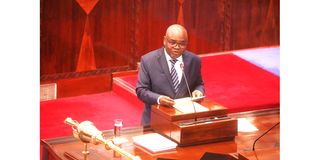
Presenting the State of the Economy Report 2025 and the National Development Plan 2026/27 in Parliament on Thursday, the Minister of State in the President's Office (Planning and Investment), Prof Kitila Mkumbo, said Tanzania was concluding the Vision 2025 era with stronger economic fundamentals despite persistent global geopolitical and economic uncertainties.
According to the report, real gross domestic product (GDP) grew by 5.9 percent in 2025, up from 5.6 percent in 2024, while GDP per capita rose by 7.4 percent to Sh3.54 million ($1,390) from Sh3.30 million ($1,264).
“The implementation of the 2025/26 National Development Plan concludes the journey of Vision 2025 and lays the foundation for the commencement of Vision 2050,” Prof Mkumbo told Parliament.
The report shows that Tanzania's economy expanded to Sh234.1 trillion ($91.81 billion) in 2025 from Sh211.98 trillion ($81.2 billion) in 2024 following GDP rebasing using 2019 as the benchmark year.
Agriculture remained the largest contributor to GDP, accounting for 24.3 percent, followed by construction (11.9 percent), mining (10.3 percent), trade and repair services (8.6 percent) and transport and storage (8.3 percent).
Financial and insurance services recorded the fastest growth rate at 15.7 percent, followed by electricity and gas (11.8 percent), mining (9.4 percent) and information and communication (8.8 percent).
The government projects economic growth of 6.3 percent in 2026 as implementation of Vision 2050 begins.
Investment reaches historic high
Investment emerged as one of the strongest-performing sectors during the year.
According to the World Investment Report 2025 published by the United Nations Conference on Trade and Development (UNCTAD), foreign direct investment (FDI) inflows into Tanzania increased by 28.3 percent to $1.72 billion in 2024, up from $1.34 billion in 2023.
Mining attracted the largest share of investment at $442.2 million, followed by financial and insurance services ($401.3 million), manufacturing ($223.1 million) and information and communication ($152.1 million).
“Overall, the statistics show that Tanzania is among the fastest-growing investment destinations in Africa and ranks 11th in terms of FDI inflows,” Prof Mkumbo said.
He also highlighted the performance of the Tanzania Investment and Special Economic Zones Authority (Tiseza), which registered 915 projects worth $10.95 billion in 2025, compared with 901 projects valued at $9.3 billion in 2024.
“This number of registered projects has broken the record for project registration since the establishment of the Tanzania Investment Centre in 1996 and subsequently Tiseza in 2025,” he said.
The projects, spanning manufacturing, commercial real estate, transport, tourism and agriculture, are expected to create 162,895 jobs.
Inflation remains stable
The report shows that Tanzania maintained relative price stability despite global energy shocks.
Average inflation stood at 3.3 percent in 2025, compared with 3.1 percent in 2024, largely driven by higher food prices. However, the rate remained within the national target range of three to five percent and met convergence criteria set by both the East African Community (EAC) and the Southern African Development Community (SADC).
Within the EAC, Tanzania recorded one of the lowest inflation rates at 3.3 percent, compared with Kenya's 4.5 percent, Uganda's 3.6 percent and Rwanda's 7 percent.
Global risks persist
Despite the positive performance, the government warned that international conflicts continue to pose risks to the economy.
Prof Mkumbo said research conducted jointly by the National Planning Commission and the United Nations Development Programme (UNDP) found that tensions involving Iran had contributed to rising oil prices, higher transport costs and supply chain disruptions.
“The war against Iran has caused panic in global oil markets due to fears of disruptions in oil transportation through the Persian Gulf and other major international shipping routes,” he said.
According to the report, crude oil prices rose from about $100 per barrel in March 2026 to $126 in April before easing to between $90 and $95 in early June.
The minister noted that Tanzania imports all refined petroleum products, with between 60 and 70 percent sourced from Gulf countries, India and Singapore.
Agriculture could also face challenges because Tanzania imports between 30 and 40 percent of its urea and DAP fertilisers from Gulf states, particularly Qatar.
However, he said the situation could also create opportunities, including providing transhipment and cargo-storage services for vessels unable to access Middle Eastern ports and attracting investors seeking alternative destinations away from conflict-prone regions.
Poverty declines, but challenges remain
The report also unveiled findings from the 2025 Household Budget Survey, the first to be conducted simultaneously in Mainland Tanzania and Zanzibar.
The proportion of people living below the basic-needs poverty line in Mainland Tanzania declined from 34.4 percent in 2007 to 28.2 percent in 2012, 26.4 percent in 2018 and 25.1 percent in 2025.
While describing the trend as encouraging, Prof Mkumbo acknowledged that poverty reduction remains slower than desired.
“The trend shows that greater efforts are required to accelerate poverty reduction so that it matches the pace of economic growth as envisioned under Vision 2050,” he said.
Five years of progress
Reviewing achievements under the Third Five-Year Development Plan and the first five years of President Hassan's administration, Prof Mkumbo said economic growth had increased from 4.7 percent in 2021 to 5.9 percent in 2025, while export earnings rose from $6.4 billion to $10.6 billion.
Major infrastructure milestones included the completion of 680.38 kilometres of the Standard Gauge Railway between Dar es Salaam and Dodoma, commissioning of the 2,115-megawatt Julius Nyerere Hydropower Project, completion of the Kigongo-Busisi Bridge and near-completion of the Kilwa fishing port project.
The report also showed unemployment declining from 8.7 percent in 2020/21 to 6.2 percent in 2024. The labour force reached 27.3 million people, while annual employment growth rose to 7.8 percent from 2.3 percent.
Vision 2050 flagship projects
The government says 2026/27 will mark the beginning of Vision 2050 implementation through the Fourth Five-Year Development Plan, which will focus on governance, economic transformation, human development, environmental sustainability and strategic enablers such as energy, transport, research and digital transformation.
Flagship projects include the Bagamoyo Marine Eco-City and Integrated Transport Hub, the Mchuchuma-Liganga coal and iron complex, a national irrigation and agro-processing programme, a rare earth minerals processing hub in Dodoma, the LNG project in Lindi, a Great Lakes industrial and blue economy hub, and an integrated urban development programme.
The 2026/27 development plan is estimated to cost Sh86.3 trillion, with the private sector expected to finance nearly 70 percent of the programme.
“Following the completion of all these Vision 2050 implementation instruments, the task before us now is only one: implementation,” Prof Mkumbo said.
Register to begin your journey to our premium contentSubscribe for full access to premium content