Dar es Salaam. In 1961, Tanganyika was richer than Singapore.
At the time, Tanganyika, which later merged with Zanzibar to form the United Republic of Tanzania in 1964, had a Gross Domestic Product (GDP) of about $2.82 billion and a GDP per capita of roughly $285.
Singapore, then still part of the Federation of Malaysia, had a smaller GDP of about $765 million, although its economy was already expanding at an estimated annual growth rate of 8.1 percent. Its GDP per capita stood at around $449.
Within a few years, however, the trajectories of the two economies would begin to diverge sharply following Singapore’s independence in 1965.
What followed has often been described as one of the most remarkable economic transformations in modern history.
Today, Singapore is a global financial hub and an advanced industrial economy with a nominal GDP estimated at about $659.5 billion and GDP per capita exceeding $107,000.
Tanzania’s economy, by contrast, is estimated at roughly $90 billion in nominal terms in 2025, supported by steady growth across agriculture, infrastructure, energy and services.
GDP per capita stands at about $1,300, reflecting both progress made and the scale of the development challenge that remains.
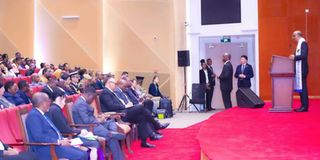
The striking contrast between the two countries formed the backdrop of a public lecture delivered at the University of Dar es Salaam (UDSM) by Singapore President Tharman Shanmugaratnam during his three-day State visit to Tanzania.
His address drew on Singapore’s development experience to highlight both the opportunities and constraints facing Africa’s economic transformation.
Speaking to students, academics, policymakers and business leaders, President Shanmugaratnam said Africa stands at a critical juncture, with the potential to become a major engine of global growth, provided it addresses structural constraints in jobs, education, energy, trade and governance.
“The future will depend less on natural resources and more on how countries invest in people, skills, institutions and regional integration,” he said.
His remarks underscored a central theme: that economic transformation is not determined by resource endowment alone, but by long-term policy choices, institutional strength and the ability to translate growth into employment and productivity gains.
Africa, he noted, is entering a period of significant demographic expansion.
The continent is home to the world’s youngest population and is expected to supply a large share of global labour force growth over the coming decades.
This presents what he described as both a historic opportunity and a profound risk.
According to World Bank projections cited in his lecture, approximately 500 million young Africans will enter the labour market over the next decade, while only about 165 million jobs are expected to be created over the same period.
“That gap of 335 million people is unprecedented in world history,” he said, warning that failure to bridge it could undermine economic progress and fuel social instability.
For this reason, he argued, employment must be treated not as a secondary outcome of growth but as its central measure.
“When we talk about jobs, they must be the measure of whether economic growth has meaning for citizens or not. Governments and societies should focus their energies on creating jobs,” he said.
He said that Africa’s development challenge has become more complex due to a rapidly changing global environment that is less favourable than the conditions under which many East Asian economies industrialised.
He pointed to shifting global trade dynamics, rising geopolitical tensions, climate change and the disruptive impact of artificial intelligence (AI) as key forces reshaping development pathways.
“The rules governing international trade and investment have become less favourable than they were when East Asia began its industrialisation journey.
AI will transform almost every sector. It will destroy some jobs, but it will also create new ones,” he said.
Despite these challenges, he maintained that Africa retains considerable policy space to shape its own economic future through deliberate reforms.
One of the most urgent areas, he said, is education. Many African education systems, he argued, continue to emphasise academic certification over practical skills, leaving large numbers of graduates insufficiently prepared for labour market demands.
He suggested a shift towards skills-based education systems that prioritise technical training, vocational education and problem-solving abilities aligned with industrial needs.
“Africa can build a higher education system focused on capabilities and skills rather than credentials. It can invest in quality vocational and technical institutions,” he said.
Such reforms, he said, would strengthen human capital development and improve the employability of graduates, while also supporting industrialisation and innovation.
Energy access was identified as another major constraint. Around 600 million Africans still lack access to electricity, a challenge that limits productivity, industrial expansion and improvements in living standards.
However, he described this as an opportunity to build modern, sustainable energy systems from the ground up, particularly through renewable sources such as solar, wind and hydropower.
“Six hundred million Africans do not have electricity. That is a problem, but it is also an opportunity to achieve energy security through a mix of renewable energy sources.
Investment in renewable energy can become a source of jobs,” he said.
He further highlighted Africa’s fragmented markets as a key barrier to growth. Despite its large population, the continent remains divided into relatively small national economies, limiting economies of scale and reducing competitiveness.
To address this, he called for accelerated implementation of the African Continental Free Trade Area (AfCFTA), which aims to create a unified continental market.
“Africa’s markets are too small and too fragmented. They do not provide the scale required to boost production and productivity. The implementation of the African Continental Free Trade Area should be accelerated,” he said.
According to him, deeper integration would enhance trade flows, attract investment, strengthen manufacturing and support job creation across borders.
Beyond economic structure, President Shanmugaratnam stressed that governance remains the foundation of long-term development success.
He said predictable policy environments, transparent institutions and respect for the rule of law are essential for attracting investment and sustaining growth.
“Good governance, policy stability, transparent institutions and the rule of law are the foundations of long-term economic transformation.
They provide confidence to investors, encourage job creation and build trust among citizens,” he said.
He also urged African countries to increase domestic resource mobilisation, noting that global aid flows are likely to decline in the coming years.
“The world has changed. We are entering a period when aid levels will be lower than they were in the past.
Africa has an opportunity to increase domestic resources and reduce revenue losses,” he said.
He added that governments should prioritise public goods such as education, healthcare and infrastructure, while enabling the private sector to drive much of the investment and job creation needed for growth.
“Most of the resources required to grow economies must come from the private sector,” he said.
Speaking during the lecture, Foreign Affairs and East African Cooperation Minister Mahmoud Thabit Kombo said Tanzania views Singapore as a powerful example of how long-term vision, strong institutions and investment in human capital can transform a country’s economic fortunes.
He said Tanzania’s Development Vision 2050 aims to raise per capita income to $7,000 by 2050, and that Singapore’s experience offers valuable lessons in innovation, governance, digital transformation and private sector development.
“Tanzania hopes to learn from Singapore’s experience in using sound policies, strong institutions and partnerships with the private sector to build a globally competitive economy,” said Mr Kombo.
Register to begin your journey to our premium contentSubscribe for full access to premium content