Samia outlines five priorities to deepen Singapore relations
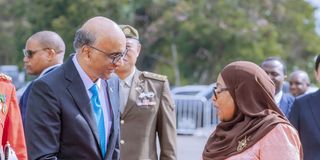
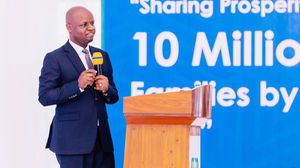
President Samia Suluhu Hassan, President of the United Republic of Tanzania, greeting the President of the Republic of Singapore, His excellency Tharman Shanmugaratnam, upon his arrival at State House in Dar es Salaam for a state visit on June 9, 2026. PHOTO | STATE HOUSE
Dar es Salaam. President Samia Suluhu Hassan on Tuesday outlined five priority sectors for enhanced cooperation between Tanzania and Singapore, as the two countries moved to translate decades of diplomatic relations into stronger trade and investment partnerships.
Addressing the Tanzania-Singapore Business and Investment Forum at the Julius Nyerere International Convention Centre (JNICC), yesterday, President Hassan invited Singaporean investors to tap opportunities in ports and logistics, value addition in agriculture and mining, renewable energy, tourism and financial services.
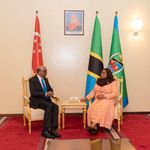
The forum followed bilateral talks between President Hassan and Singapore President Tharman Shanmugaratnam at State House earlier in the day, where the two leaders witnessed the signing of five agreements covering taxation, trade facilitation, skills development, climate cooperation and diplomatic consultations.
President Hassan said Tanzania and Singapore had maintained strong relations over the past 45 years, but economic cooperation remained far below its potential.
“While our diplomatic relations remain strong and cordial, there is considerable untapped potential to further deepen and expand the economic dimension of our partnership,” she told business leaders from both countries.
She noted that bilateral trade rose from $74 million in 2020 to a peak of $299 million in 2023 before declining sharply to $74 million in 2024, a trend she said highlighted the need for more resilient economic ties.
“Our trade structures are not yet resilient, and we must adopt deliberate measures to address these discrepancies,” she said.
The President said Tanzania was looking to leverage Singapore’s globally recognised expertise in logistics, industrialisation, urban planning and investment promotion as the country pursues its ambition of becoming a $1 trillion economy under Vision 2050.
The first priority area identified by President Hassan was ports and logistics, where she said Tanzania’s strategic location gives it a unique advantage as a gateway to East, Central and Southern Africa.
“The Port of Dar es Salaam handles the bulk of this transit trade. A partnership with a world-class operator from Singapore will greatly enhance our port productivity and anchor Singapore’s ambition to be the hub connecting Africa to Asia,” she said.
She pointed to ongoing and planned projects, including the expansion of the Dar es Salaam Port, the Bagamoyo Port Industrial Complex and port developments in Zanzibar, as areas where Singaporean expertise could play a significant role. Agriculture and mining value addition emerged as the second priority sector.
President Hassan said Tanzania was keen to move away from exporting raw commodities and instead develop processing industries capable of serving Asian and global markets.
“Too much of our gold and gemstones leave our borders without value addition. If refined in the country, they can help us move from exporting raw commodities to processed and branded products highly sought after in global markets,” she said.
She also proposed long-term agricultural trade arrangements that could see Tanzania supply products such as coffee, tea, cashew nuts and spices to Singapore as the city-state seeks to diversify its food import sources.
Renewable energy and smart infrastructure formed the third pillar of cooperation.
With growing industrial demand and abundant solar, wind, geothermal and natural gas resources, Tanzania sees Singapore as a potential partner in advancing green technologies and sustainable infrastructure.
The fourth area focused on tourism, hospitality and the blue economy.
President Hassan said Tanzania welcomed approximately 2.3 million international visitors last year, but Asia remained an underdeveloped tourism market.
“There is a key opportunity in tourism infrastructure, destination marketing and stronger connectivity between our countries. Let us work together to boost tourism flows,” she said.
Financial services and commercial dispute resolution completed the list of priorities.
As Tanzania seeks financing for major infrastructure projects, the President said the country would benefit from Singapore’s expertise in capital markets, project finance and internationally recognised arbitration systems.
“We welcome partnership in developing an international financial centre and establishing an internationally accredited arbitration and commercial dispute resolution centre to foster investor confidence,” she said.
President Shanmugaratnam echoed the call for stronger economic engagement, arguing that growing uncertainty in the global trading system required countries to build new partnerships and diversify supply chains.
“In such a world, the answer must be to diversify, to build new corridors of opportunity and wider, more resilient supply chains,” he said.
Describing Tanzania as a country of “immense promise”, he cited its youthful population, strategic location, natural resources and expanding investment opportunities as factors attracting growing interest from Singaporean businesses.
“If we can work this complementarity between our two economies well, it can create good jobs, higher capabilities and inclusive growth,” he said.
He also welcomed plans for negotiations on a free trade agreement between Singapore and the East African Community (EAC), describing it as a potentially transformative step for trade between East Africa and Southeast Asia.
Earlier, Minister of State in the President’s Office (Planning and Investment), Prof Kitila Mkumbo, said Singapore’s economic transformation offered important lessons for Tanzania as it seeks to accelerate industrialisation and attract investment.
“President Samia’s economic approach is very clear. It is pragmatic. We are going around the world not looking for aid, but looking for trade and investment opportunities,” he said.
Prof Mkumbo said Singapore’s rise from a low-income country to one of the world’s leading economies demonstrated what could be achieved through strategic planning, investment and openness to global markets.
“The story of Singapore is a story admired around the globe. It is a journey from which Tanzania can draw valuable lessons as we pursue our own development ambitions,” he said.
The forum brought together government officials, investors and business leaders from both countries, with participants expressing optimism that the agreements signed and commitments made would pave the way for stronger commercial ties between Tanzania and Singapore.
Register to begin your journey to our premium contentSubscribe for full access to premium content