Samia’s diplomatic drive gains momentum with historic Singapore state visit
By Mindi Kasiga
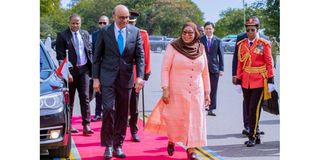
Less than 72 hours after concluding a State Visit to the Russian Federation, President Samia Suluhu Hassan was back on the diplomatic stage in Dar es Salaam, welcoming Singaporean President Tharman Shanmugaratnam on the first State Visit ever undertaken by a Head of State from Singapore to Tanzania.
The rapid succession of high-level engagements reflects Tanzania’s increasingly active international diplomacy and its deliberate pursuit of strategic partnerships capable of advancing national development priorities under Vision 2050.
President Tharman’s visit, which coincides with the 45th anniversary of diplomatic relations between Tanzania and Singapore, marks a significant milestone in bilateral relations and signals a shared commitment to expanding cooperation in trade, investment, skills development, digital transformation, food security, healthcare and climate resilience.
Speaking after official talks at State House, President Samia described the visit as historic, noting that it comes at a time when Tanzania is intensifying efforts to attract investment, strengthen economic competitiveness and equip its youthful population with the skills required for a rapidly changing global economy.
The discussions highlighted Tanzania’s pragmatic foreign policy approach, which increasingly places economic diplomacy at the centre of international engagement. By strengthening partnerships across diverse regions, from Eurasia to Southeast Asia; Tanzania is positioning itself to leverage global opportunities in support of its long-term development agenda.
“Our friendship is bigger than the current levels of trade and investment,” President Samia said while emphasizing the need to expand economic cooperation beyond its current scale.
The two leaders agreed to strengthen collaboration in strategic sectors including logistics, industrial development, agribusiness, education, healthcare and the digital economy. Several agreements signed during the visit are expected to provide a stronger framework for future trade and investment flows between the two countries.
For Tanzania, the significance of the visit extends beyond bilateral relations. It underscores the country’s growing profile as a regional gateway economy and an increasingly influential actor in Africa’s engagement with Asia.
President Tharman described Tanzania as a country “confident in its potential and well placed to shape the opportunities ahead,” citing its strategic location, youthful population and expanding role within the East African Community (EAC).
His remarks come at a time when Tanzania’s regional influence is becoming increasingly evident. Just last month, the Presidents of Rwanda and Kenya each undertook official visits to Tanzania, underscoring the country’s growing strategic importance to both their respective national interests and the wider East African region.
Earlier in March, President Yoweri Museveni of Uganda also visited Tanzania ahead of the EAC Summit at which Uganda assumed the Chairmanship of the Community from Kenya. The transition coincided with another important development for Tanzania’s regional standing, as a Tanzanian national assumed the position of Secretary General of the EAC Secretariat. These developments reflect Tanzania’s prominent role in shaping regional integration, economic cooperation and political dialogue within East Africa.
The visit also generated momentum for discussions on a possible Free Trade Agreement between Singapore and the East African Community, a move that could significantly strengthen economic linkages between East Africa and Southeast Asia while opening new opportunities for trade, investment, technology transfer and digital cooperation.
Beyond its bilateral significance, the proposed agreement highlights Tanzania’s growing role as a bridge between regional and global markets. As host of the EAC Headquarters, one of the Community’s founding members and one of its largest economies, Tanzania is strategically positioned as a gateway for international partners seeking engagement with East Africa.
In this context, the prospect of an EAC-Singapore Free Trade Agreement carries strategic importance not only for Tanzania but for the entire region, potentially creating new avenues for market access, supply-chain integration and economic diversification at a time of significant shifts in the global trading system.
President Samia’s recent engagements with both Russia and Singapore illustrate the evolution of Tanzania’s foreign policy in a rapidly changing global environment.
While firmly anchored in the country’s longstanding principles of independence, sovereignty and non-alignment, Tanzania is increasingly pursuing a strategy of diversified international engagement that seeks constructive partnerships across regions and political blocs.
This approach reflects a foreign policy that remains non-aligned yet actively multi-engaged, guided not by geopolitical rivalries, but by national interests, mutual benefit and development priorities.
Through strategic partnerships with countries across Africa, Asia, Europe, the Middle East and the Americas, Tanzania is advancing a diplomacy increasingly defined by diversification, economic pragmatism, knowledge exchange and investment promotion.
As the country moves towards the aspirations of Vision 2050, such an approach positions Tanzania to leverage global opportunities while maintaining the strategic autonomy that has long been a hallmark of its foreign policy.
Ambassador Mindi Kasiga is the Director of Communication for the Ministry of Foreign Affairs and East African Cooperation.