Mbinga farmers reap major gains as coffee revival gathers momentum
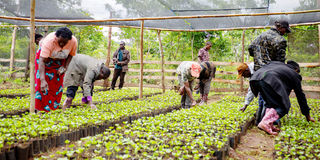
Coffee farmers from the Mangwagala Group in Kitanda Ward, Mbinga District, tend to their coffee seedling nursery during a visit by officials from the German-based non-governmental organization Hanns R. Neumann Stiftung (HRNS) at the weekend. PHOTO | COURTESY
Mbinga. Coffee growers in the highlands of Mbinga District are reporting rising productivity and strong returns in the latest transformation influenced by three years of targeted support.
Farmers say the intervention from the government and Germany-based non-governmental organisation Hanns R. Neumann Stiftung (HRNS), has reshaped how they cultivate, process and market their crop, ushering in what some describe as a new chapter for coffee production in Ruvuma Region.
Over the past three years, HRNS initiatives have reached about 2,000 smallholder farmers organised into 65 groups and 10 Agricultural Marketing Cooperative Societies (Amcos). The programme has focused on practical training in modern agronomic practices, nursery management and cooperative governance.
Participating farmers have also adopted diversified agroforestry systems, integrating shade and fruit trees into their coffee farms to improve soil health, enhance resilience to climate change and create additional income streams.
During a recent visit by HRNS officials, leaders of beneficiary groups and Amcos reported that coffee prices rose from an average of Sh7,000 per kilogramme to more than Sh11,000 per kilogramme in the last season. Growers attributed the increase to improved quality, better post-harvest handling and stronger participation in auctions and formal markets. “These changes translate directly into better livelihoods for farmers and renewed hope for young people who now see agriculture as a dignified and viable profession,” said chairperson of 29-member Ngwindi Group, Mr Steven Milinga.
Mr Milinga said the training had enabled his group to produce 30,000 coffee seedlings towards a target of 150,000. The group has also secured a Sh70 million loan from the district council to construct a guest house in Mpapa Ward, Mbinga Rural.
“We have big ambitions despite challenges, including the need for shade nets, adequate seedling tubes and improved water systems from the mountains to support irrigation in our nurseries,” he said.
In the same ward, chairperson of Kigoti Amcos, Ms Grace Ndunguru, said the project had delivered visible changes in both production and management.
“We started by learning how to establish nurseries using improved coffee variety seeds supplied by the Tanzania Coffee Research Institute (TaCRI). Today, we sell high-quality seedlings to our members and private buyers,” she said.
An extension officer and member of Namangw’ina Group in Kitanda Ward, Mr January Komba, said access to improved seeds, water pumps and seedling tubes had significantly reduced transplanting losses. “The difference between the past and now is remarkable. We see healthier farms and higher productivity,” he said.
Speaking on behalf of HRNS, agricultural expert Mr Isack Lungu said farmers previously faced multiple constraints, including limited access to quality seedlings, inadequate knowledge of modern agronomy and insufficient capital.
“They were working hard but without the right tools and up-to-date knowledge. Today, they are equipped to establish and manage nurseries, apply inputs correctly and fertilise in a structured manner that boosts yields. We are witnessing healthier farms and better harvests,” he said.
Several Amcos have received shade nets, seedling tubes and improved starter seeds, enabling them to increase production of disease-resistant seedlings and strengthen long-term sustainability.
According to HRNS producer organisation trainer Mr Benson Wanyoike, improved cooperative governance has also played a crucial role.
“Farmers now understand their rights and responsibilities, participate actively in auctions and track market prices more closely,” he said, noting that recent price gains were driven largely by global demand dynamics.
Beyond coffee, the 65 beneficiary groups have diversified into beekeeping, fish farming, avocado cultivation and small-scale hospitality ventures. The strategy aims to reduce overdependence on a single crop while strengthening household resilience.
In response to climate change, HRNS has distributed more than 200,000 shade and fruit trees across Mbinga. The trees improve farm shading, enhance soil fertility and help absorb carbon emissions.
“We are building farms that can withstand rising temperatures and unpredictable rainfall. This is an investment for the next generation,” Mr Lungu said.