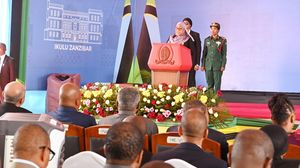
Cape Town. Tanzanian conglomerate MeTL Group expects to surpass $3 billion (about Sh7.8 trillion) in annual revenue this year, with Chief Executive Officer, Mohammed Dewji, attributing the growth to decades of investment in manufacturing, value addition and the revival of struggling industries.
Speaking at Standard Bank’s Business and Commercial Banking Conference, Africa Unlocked, in Cape Town, Mr Dewji said MeTL’s transformation from a trading company into a major African manufacturing conglomerate demonstrates the long-term benefits of investing in production despite challenging business conditions.
The group now manufactures more than 50 product categories, operates in 11 African countries and employs more than 40,000 people. It expects to generate over $3 billion in revenue in 2026 as it continues expanding its industrial footprint.
"We never asked what business we should enter. We asked what problems we could solve," Mr Dewji told delegates, explaining that this approach guided MeTL’s expansion into food processing, edible oils, beverages, textiles, soaps, detergents and other consumer products.
He said the company’s growth strategy has included acquiring underperforming manufacturing plants, many of which were privatised during Tanzania’s economic reforms, and transform them into profitable operations.
"Rather than sitting in a comfortable office, I spent long days on factory floors alongside our teams, helping turn struggling businesses into successful manufacturing operations. We saw potential where others saw problems," he said.
Mr Dewji said MeTL began as a trading business distributing essential goods across Tanzania but later realised that sustainable economic growth could not be achieved through commerce alone.
After returning to Tanzania from Georgetown University, he chose to invest heavily in local manufacturing rather than expanding the company’s trading activities.
"We believed Africa could not build lasting prosperity by exporting raw materials and importing finished products," he said.
He said one of the major challenges during MeTL’s expansion was access to finance, particularly during the early stages of Tanzania’s financial sector reforms.
"When we started expanding, Tanzania’s banking sector was still developing. In 1998, the country’s largest commercial bank had paid-up capital of about $10 million.
This meant the maximum financing available to a business like ours was around $2 million, far below what was needed to support our ambitions," he said.
Unable to secure sufficient financing locally, MeTL sought funding from international sources.
"We knocked on many doors. Many saw the potential, but few were prepared to back the ambition," he said. Mr Dewji credited Standard Bank with becoming one of the first financial institutions to support the group’s expansion, describing the partnership as important to MeTL’s growth.
He said while financing remains essential for businesses, entrepreneurs also require resilience, confidence and a long-term vision.
"Capital matters. But confidence and resilience matter first," he said.
Graphite processing
Looking ahead, Mr Dewji said MeTL is applying its value-addition strategy to the mining sector through investments in graphite processing in Mozambique.
Instead of exporting raw graphite, the company plans to process the mineral locally to supply growing demand from electric vehicle battery manufacturers, renewable energy storage projects and advanced manufacturing industries.
The group expects to commission a processing plant within the next year with the capacity to produce about 50,000 tonnes of graphite annually at around 95 percent purity.
Over the medium to long term, MeTL plans to invest more than $250 million to produce 99.5 percent battery-grade graphite, which is used in electric vehicle batteries.
"For too long, Africa has exported raw materials and imported finished products. The real value lies not simply in mining, but in processing," Mr Dewji said.
He said the investment reflects MeTL’s broader belief that Africa’s economic transformation depends on producing higher-value goods rather than remaining primarily an exporter of raw materials.
During the conference, Standard Bank Group’s Chief Executive for Business and Commercial Banking, Bill Blackie, said Africa’s next phase of economic development would depend on strategic investments in energy, infrastructure and stronger financial markets.
"Energy and infrastructure are the foundation on which everything else is built," Mr Blackie said, noting that Africa possesses significant solar resources and critical minerals needed to support the global transition to clean energy.
He said these resources present opportunities for the continent to build competitive industries, but access to capital remains critical in converting potential into successful businesses.
Mr Blackie said Africa’s financial systems have evolved significantly, providing businesses with more advanced financing options and improved access to international markets.
"Capital is the accelerant. The instruments that allow African businesses to grow, protect what they have built and access international markets are more sophisticated and accessible than at any point in this continent’s commercial history," he said.
He said stronger capital markets and improved access to finance would be essential for enabling African companies to expand, support industrialisation and compete in global markets.
Register to begin your journey to our premium contentSubscribe for full access to premium content