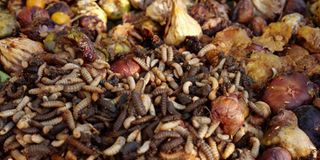
Dar es Salaam. Tanzania is testing an innovative waste management technology that uses Black Soldier Fly (BSF) larvae to transform organic waste into high-protein animal feed and organic fertiliser.
The trials offer what scientists believe could become a practical solution to the country’s growing urban waste crisis while creating new economic opportunities.
The pilot project, launched recently in Babati, Manyara Region, by the National Commission for Science and Technology (COSTECH), seeks to demonstrate how organic waste can be diverted from landfills and converted into valuable commercial products.
Although the trial is being conducted in Babati, experts say its greatest potential lies in rapidly expanding cities such as Dar es Salaam, where municipal authorities face mounting challenges in managing ever-growing volumes of waste.
As Tanzania’s urban population continues to increase, waste generation has risen sharply.
Dar es Salaam alone produces an estimated 5,000 to 6,000 tonnes of solid waste every day, according to figures from the city council and urban development studies.
Between 55 and 65 percent of that waste consists of biodegradable material from households, food markets, hotels and restaurants.
Much of this organic waste ends up at disposal sites such as Pugu Kinyamwezi or is dumped into drains, rivers and open spaces. Besides creating unpleasant odours, it contributes to blocked drainage systems, flooding during the rainy season, greenhouse gas emissions and growing public health concerns.
Scientists say Black Soldier Fly technology directly addresses this waste stream by using larvae that rapidly consume decomposing organic material.
Within a matter of days, the larvae can reduce the volume of waste by as much as 70 percent while producing commercially valuable by-products.
Unlike common houseflies, adult Black Soldier Flies do not feed on human food and are not regarded as vectors of disease. Their larvae, however, consume large quantities of organic waste before being processed into protein-rich livestock feed.
The remaining residue becomes nutrient-rich organic fertiliser that can improve soil fertility and reduce dependence on chemical fertilisers.
Speaking during the launch of the Waste Management and Recycling Innovation Hub in Babati, COSTECH Director of the Centre for Development and Transfer of Technology (CDTT), Dr Nora Mdee, said scientific assessments indicate that the technology offers both environmental and economic benefits.
“This technology contributes significantly to environmental conservation by reducing decomposing waste while producing valuable products for society,” she said.
The initiative comes as governments across Africa search for more sustainable ways of managing municipal waste.
The World Bank has repeatedly warned that rapidly urbanising African cities risk facing an escalating waste crisis unless investment in recycling systems and circular economy solutions keeps pace with population growth.
Environmental economist Dr Marc Ngoteya of the University of Dar es Salaam said Tanzania has historically treated waste largely as a sanitation problem rather than an economic resource.
“We have been spending billions of shillings transporting waste to landfills where it simply accumulates,” he told The Citizen.
“The circular economy encourages us to recover value from waste before disposal. Black Soldier Fly technology fits perfectly within that model because it reduces landfill pressure while creating entirely new value chains.”
According to Dr Ngoteya, cities including Dar es Salaam, Mwanza, Arusha and Dodoma could substantially reduce waste management costs if households and businesses separated organic waste at source before it was channelled into insect-based recycling facilities.
Scientists also believe the technology could help address another long-standing challenge facing Tanzania’s agricultural sector, the high cost of livestock feed.
Feed accounts for between 60 and 70 percent of poultry and fish production costs, with many manufacturers relying on imported fishmeal and soybean products as major protein sources.
These imports raise production costs and ultimately affect food prices.
Aquaculture researcher Dr Esther Msuya said Black Soldier Fly larvae provide a sustainable and locally available alternative.
“The nutritional quality of BSF protein is excellent for poultry and fish,” she said. “If production is scaled up locally, farmers could access cheaper feed while reducing dependence on imported raw materials. That strengthens food security and improves competitiveness.”
Local authorities also see wider economic benefits.
Babati Municipal Director Shaaban Mpendu said the council generates about 85 tonnes of waste every day.
Rather than becoming an environmental burden, he said much of that waste could support new businesses involved in waste collection, larvae production, feed manufacturing, fertiliser processing and organic farming.“This is not just about cleaning our town,” he said.
“It is about creating employment and new sources of income for our people.”If successfully scaled up, scientists believe the technology could transform how Tanzania manages organic waste, turning one of its fastest-growing environmental challenges into a source of jobs, agricultural inputs and cleaner, more sustainable cities.
Register to begin your journey to our premium contentSubscribe for full access to premium content