Josephine Christopher is a senior business journalist for The Citizen and Mwananchi newspapers
Mwananchi Communications Limitted
Dar es Salaam. Tanzania is accelerating its shift towards natural gas as a central pillar of its energy and economic strategy, aiming to shield the economy from volatile global fuel prices while reducing costs for businesses and households.
In an interview with The Citizen, the Permanent Secretary for Electricity and Renewable Energy, Mr Felchesmi Mramba, said the government is expanding the use of domestic natural gas beyond power generation into transport and industry as part of a broader structural energy transition.
“The government is promoting the adoption of gas-powered vehicles through incentives, including support for conversion technologies and development of refuelling infrastructure,” he said.
The strategy comes amid persistent fluctuations in global oil markets, which continue to expose import-dependent economies to price shocks and foreign exchange pressures. In Dar es Salaam, petrol currently retails at about Sh3,820 per litre and diesel at Sh3,806 following the latest monthly price cap adjustment.
Against this backdrop, Tanzania is positioning its domestic gas reserves as a stabilising buffer for its energy system.
Energy Minister Deogratius Ndejembi, in his 2026/27 budget speech, said the country had produced more than 41 billion cubic feet of natural gas by March 2026. He said ongoing infrastructure expansion is aimed at ensuring reliable and affordable energy for national development.
He added that more than 20,000 vehicles—including cars, buses, trucks and three-wheelers—have already been converted to run on compressed natural gas (CNG).
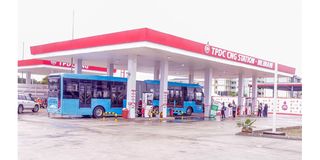
To support the transition, the government has rolled out at least 18 operational CNG refuelling stations, with eight more under construction. Plans are also underway to introduce mobile refuelling units to improve access beyond major urban centres.
Private sector participation is also growing, with several firms licensed to operate across the gas value chain, including distribution, infrastructure development and vehicle conversion services.
According to the minister, the cost of installing gas systems in small vehicles has fallen to between Sh1.5 million and Sh1.8 million, down from as high as Sh2.5 million previously, making conversions more accessible to individual motorists and fleet operators.
Parliament has also approved Sh2.5 trillion for the energy sector in the 2026/27 financial year, covering electricity expansion, gas development and infrastructure upgrades.
Uneven pricing in conversion market
Despite rising uptake, industry players say the CNG conversion market remains fragmented, with no uniform pricing structure.
TAQA Arabia CNG engineer Satary Killimbah said costs vary significantly depending on service providers and installation standards.
“Prices have not really come down uniformly,” he said. “Established companies may offer some level of subsidy, but informal garages often charge differently and sometimes even higher depending on circumstances.”
He noted that global fuel price volatility has also pushed up the cost of key components such as cylinders and conversion kits.
“Rising fuel prices have increased the cost of spare parts used in conversions,” he said. “So while service charges may appear stable in some cases, equipment costs have gone up.”
Mr Killimbah said this trend has contributed to rising demand for CNG conversions, particularly among commercial drivers and urban motorists seeking cheaper alternatives to petrol and diesel.
He added that demand is now straining supply chains for cylinders and related equipment, with increased local uptake driving shortages in some cases.
Full conversion costs, he said, vary depending on vehicle type and specifications but average around Sh1.6 million in structured service centres.
However, he stressed that the market remains largely unregulated, with prices fluctuating between providers.
The growing gap between petrol prices and gas is accelerating the shift towards CNG.
Officials from the Tanzania Petroleum Development Corporation (TPDC), through its Gas Company Limited, which operates the Sam Nujoma Road CNG station, said rising fuel costs are driving consumer behaviour.
Gasco senior mechanical engineer Flora Benedicto said there has been a noticeable increase in new users converting vehicles after recent fuel price hikes.
“We are seeing a significant rise in new customers who converted after fuel prices went up,” she said.
She noted that CNG, currently retailing at about Sh1,550 per kilogramme, is significantly cheaper than petrol and diesel, which are both around Sh3,800 per litre.
At one station alone, daily usage rose from 492 vehicles, 1,200 tricycles and 37 buses on April 1 to more than 700 vehicles and over 55 buses by April 23.
She said this reflects only one station, suggesting national uptake is higher as infrastructure expands.
Growing investor interest
The rising demand is also attracting investment interest.
BQ Contractors Limited CEO, Mr John Bura, said inquiries into CNG station development have increased significantly.
“We are receiving many enquiries from investors interested in CNG infrastructure,” he said.
He added that uncertainty in global fuel markets strengthens the case for long-term investment in gas as a more stable domestic energy source.
“Even if fuel prices fall, they are unlikely to drop significantly. That makes CNG a long-term solution rather than a temporary alternative,” he said.
He noted that Tanzania’s large gas reserves provide a strong foundation for expansion, though challenges remain, particularly high conversion costs and limited financing access.
He also pointed to regional trends, citing Rwanda’s push towards alternative energy policies as an example of long-term planning in the transport sector.
Register to begin your journey to our premium contentSubscribe for full access to premium content