What China really wants from Africa in new era of global trade
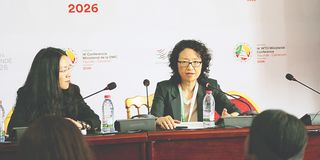
The head of the permanent mission of China to the World Trade Organization (WTO), Li Yongjie, speaks during the 14th Ministerial Conference (MC14) in Yaoundé. PHOTO | COURTESY
Josephine Christopher is a senior business journalist for The Citizen and Mwananchi newspapers
Mwananchi Communications Limitted
Yaoundé. As Tanzania pushes to industrialise and expand exports, China is signalling a shift in how it wants to engage with Africa—placing less emphasis on traditional infrastructure deals and more on production, market access and integration into global value chains.
Speaking during the 14th Ministerial Conference (MC14) of the World Trade Organization(WTO) last week, head of the permanent mission of China to the WTO, Li Yongjie, outlined a strategy that aligns with Africa’s broader ambition to move beyond raw commodity exports.
At the centre of China’s approach is a stronger push to support industrialisation across the continent.
“We also encourage Chinese companies to invest in sectors such as agricultural processing, auto assembly, home appliances, new energy and digital economy, in order to integrate more African production into the global value chain and create more jobs for local people,” she said.
The focus on agro-processing and light manufacturing reflects a growing effort to shift African economies toward value addition rather than raw exports, particularly in sectors where jobs and income generation can expand quickly.
Ambassador Li also linked investment to infrastructure, especially projects that reduce trade costs and improve efficiency.
She said, “We encourage Chinese companies to participate in African infrastructure projects on a commercial basis, so as to help reduce logistics costs.”
High transport and logistics costs remain a persistent barrier across many African economies, limiting competitiveness despite growing production potential.
China’s approach is also shaped by the scale of its domestic market, which continues to drive demand for imports.
“China never seeks trade surpluses. Our enormous market generates strong demand for global goods and services.”
In 2025, China’s imports reached 18.48 trillion-yuan, equivalent to about $2.64 trillion, maintaining its position as the world’s second-largest import market for 17 consecutive years.
Ambassador Li said, “China always believes action speaks louder than voice. China welcomes more high-quality products and services from all over the world.”
In a move expected to deepen trade ties, China has announced that it will implement zero-tariff treatment for 53 African countries with diplomatic relations starting May 1 this year.
“I must emphasize that zero-tariff treatment is not just a trade measure, but also an investment tool,” she said.
The policy is expected to ease entry for African goods into the Chinese market, while also making the continent more attractive to investors seeking production bases with preferential access.
She added, “While supporting African exports, we hope the policy helps attract global investments to Africa and accelerate Africa’s integration into the global supply chain.”
The measure comes as global supply chains continue to shift, with companies seeking new production locations and diversified sourcing options.
Recent data suggests the transition toward value addition is already underway.
An International Monetary Fund report cited during the conference indicates that Chinese investment has contributed to increasing local processing rates in Africa from 15 percent to 45 percent.
This points to a gradual move away from raw commodity dependence toward more diversified production, although challenges remain in scaling up industrial capacity.
Ambassador Li emphasised that China’s approach is rooted in broader South-South cooperation, aimed at supporting developing countries to integrate more effectively into global trade systems.
She also reiterated China’s support for the African Continental Free Trade Area, which is expected to boost intra-African trade and create larger markets that can attract investment.
Her remarks reflect a wider shift in global trade dynamics, where partnerships are increasingly defined by production, market access and shared growth.
The direction of travel is becoming clearer: deeper integration into global value chains will depend not just on what countries export, but on how much value they add and how competitive their industries become.
Register to begin your journey to our premium contentSubscribe for full access to premium content