War was the last thing on their minds; these Tanzanian girls had blended so well with other students, just like all young people do on campuses.
New culture, new friends, everything was calm.
“I spent most of my time with my Indian, Sudanese, Pakistani, and Lebanese friends,” UmmyKulthum Nasser said.
Their dream was to graduate and find jobs in Tanzania.
Their mother in Kibaha was counting the days before her girls got back home.
She knew it would be a few years for the younger and a year for the older one, but little did she know that a war was brewing.
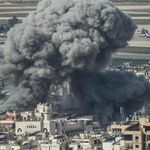
Israel and the United States of America coordinated airstrikes, and the bombardment of Iran started on February 28.
To Tanzanians, the war might seem remote and only viewed from their smartphones, gasping at the horrific deaths, but for the Nasser sisters, this war came right on their back yards.
As the missiles and drone attacks started, UmmyKulthum was in bed sleeping; she had no idea what was going on outside her window.
She picked up her phone to scroll through her favourite social media pages when she noticed there was no internet.
Her initial assumption was that her internet got cut or she ran out of data, trying to remember if she had paid for it or not.
She didn’t think much of it.
She just woke up and started to clean her room and do a few chores.
When she was done and stepped out of the dormitory, she began hearing whispers and rumors that the war had started.
“I was in disbelief at first, I told them, there is no way,” she remembers.
Fellow students told her it’s a fact, and that’s why there is no internet access.
That’s when it hit her, that indeed. The country that she has called home for one year is under attack.
Fatma heard the loud noises as the bombs were dropping on an oil reserve in Tehran, though it was not near her residence, the sounds felt uncomfortably close.
“We had to go outside, and I looked up; I was the missile; I was scared that anytime one would drop on us, and we would be done,” she narrated.
Five missiles were dropped near her hostel.
She was terrified, considering that some of the missiles were reported to have consumed the lives of 168 students, when they obliterated Shajareh Tayyebeh girls’ primary school in Minab.
Fatma remembers her hostel building just shaking and the door flung open, and seeing fire raining from the sky.
“I left my fate to Allah; if he wanted me gone, so be it,” she said.
The last war wasn’t that scary; it lasted just 12 days.
This one was an escalation; they assassinated the Supreme Leader,” said Fatma with tears in her eyes.
Fatma, who is a Shia Muslim, said.
This is the greatest loss, unimaginable.
”UmmyKulthum couldn’t believe it when she was told of his demise; she just thought it was fake news.
It came as a shock to her.
Amidst all the bombardments, thousands of Iranians gathered at Enghelab Square in Tehran to mourn Ayatollah Sayyid Ali Hosseini Khamenei.
“It was not only a loss to Iran, but to Shias and Muslims across the world,” she said.
“I thought the war would last for a week and it would end,” UmmyKulthum added.
The War has been ongoing for 7 weeks now, with the ceasefire agreement barely holding.
The evacuation of 11 Tanzanian students commenced when it was clear that the war would drag on much longer than expected.
Fatma had to leave Tehran and join her sister in Qazvin.
In the depths of the night, Tanzanian officials had organized a Bus for all students available to head to the northwestern Turkish Border.
They traveled through the night and by 8;00 am the next morning, they had arrived at the border.
“Our Ambassador was waiting for us at the border,” Ummykulthum said.
They were whisked away to the city of Van, which is roughly 150 kilometers from the border, and there, they were each given a room to recuperate.
The next morning, they had to leave and take a domestic flight to Istanbul, where Air Tanzania, the National Carrier, was waiting to take them back home.
“When Tanzanians face problems abroad, the one who is supposed to rescue us is our government,” Fatma said.
During the War, families and friends couldn’t get visas to rescue them.
At that moment, only diplomatic channels are used.
Fatma explained that a visa takes nearly a month, but government-to-government communication can forgo all that due process.
Some Tanzanians who chose to stay in Iran remained behind.
Contrary to what has been said in the media, Ummykulhum said life for women in Iran is not restrictive at all.
“Some women even walk around with their heads half covered, and they are not bothered by the police as insinuated in Western media reporting,” she said.
These ladies were among many young Tanzanians, on scholarship provided by the Iranian government.
For UmmyKulthum, it was more than just studies; she was fascinated by the Persian culture, from their food, language, music, and their everyday lives.
At traditional events, Ummykulthum and other foreigners were always welcomed into Iranian homes, where they were given food and celebrated with the locals.
“Most people think Iran is just a place for Islamic studies, but it has leading Science, Technology, law, and other highly ranked universities,” Fatma explained.
“They teach in English and Persian,” she added.
Studying abroad for Fatma was advantageous.
As a Lawyer with an International degree and an additional language, Persian, she views that as an important factor in her CV.
“I always say when I apply for a job, and they see that beyond the degree, I have an additional language, they will consider me above others,” she explained.
In this competitive job market, she knows hunting for one equipped with that would open more doors.
“I could also teach people Persian as a language; few people know it here, and I can start something, teach it as a source of income,” she explained.
Fatma, who is on an Iranian government scholarship, is studying at Ahlul Bayt International University in Tehran, which is also government-run.
Saw that as an opportunity to seek government employment later.
Fatma never thought she would be back in Tanzania so soon.
She was supposed to graduate in February of 2027.
She doesn’t know what lies ahead, but she is glad she is safe and sound at home, next to her mother.
“When my mum saw me, she hugged me and started crying,” Ummykulthum recalled.
They are hoping everything will get back to normal so that they can resume their studies.
But Fatma is also seeking alternatives.
Any university that will allow her to finish her two remaining semesters.
“It is not easy to find a university that accepts me to study for the remaining year, but I will try,” she said.
For Ummykulthum, she has not made up her mind whether she will find another university abroad or study in Tanzania.
All options are on the table as they await the news of the war.
It all depends on how long the war will take.
“I do not hate Americans or Israelites, as the people; we see them protesting the war in their countries too, but I hate the politicians; they have destroyed so many people’s lives,” Ummykulthum said.
Register to begin your journey to our premium contentSubscribe for full access to premium content