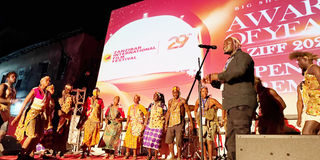
The screening of 'We Are Hadza' at the ZIFF Main Venue, located behind Mizingani Hotel in Stone Town, unfolded in a mood that felt both ceremonial and quietly intimate.
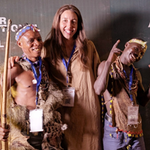
As evening settled over the coastal city, audiences gradually filled the open-air theatre space, creating a gathering that brought together filmmakers, festival-goers, and members of the Hadza community who had travelled from northern Tanzania for the film’s African premiere.
There was a subtle but undeniable shift in the atmosphere when the Hadza guests arrived.
Their presence did not sit at the margins of curiosity but at the centre of attention, reshaping the emotional rhythm of the room.
Conversations softened almost instinctively, and what had been a lively festival environment gave way to a shared sense of anticipation.
It was less about watching a screening and more about witnessing a moment that already felt significant before the film began.
When the lights dimmed, the sounds of Zanzibar night, distant movement, sea air and fragments of conversation blended into the opening frames of We Are Hadza.
The film did not announce itself with force but settled into the space gently, unfolding with a patience that invited attention rather than demanded it.
Across the audience, reactions were restrained yet deeply present. There were soft moments of laughter, quiet murmurs of recognition, and extended silences where the imagery seemed to linger longer than the screen itself.
At the end of the screening, applause rose steadily rather than explosively, carrying more the weight of acknowledgement than performance.
It felt like a collective pause, as though the audience had not only watched a film but also spent time in the presence of a lived reality.
For Mama Africa, one of the festival attendees, the film carried meaning far beyond its cinematic form, particularly in how it portrayed the Hadza community’s agency in defining its own boundaries.
She observed that what stood out was their clarity and directness in addressing the outside world.
“What I appreciated most is how direct they are. The Hadza clearly express themselves and even warn against exploitation.
They are very aware of their land and how it should be protected. They are not silent in their story; they are in control of how they want to be seen,” shares Mama Africa.
Her remarks underscored a central thread in the film, a community that is not positioned as passive subjects of documentation but as active narrators of their own reality.
Filmlover Saima Noor also reflects on the screening, drawing attention to the film’s portrayal of cultural continuity within a rapidly changing world.
She notes the balance between modern exposure and the preservation of identity.
“I liked how honest and free they are in the documentary," she explains.
Further adds, "What stood out for me is that even those who are educated still hold on to their culture.
There is a young boy who speaks English and Kiswahili, but he still communicates in his local language. That balance really touched me.”
Her observation highlights one of the film’s quiet strengths, the coexistence of education, multilingualism and deep-rooted tradition without one displacing the other.
One of Tanzania’s Indigenous communities is still actively preserving its traditional way of life.
The We Are Hadza documentary offers audiences a glimpse into a world shaped by hunting and gathering practices, deep ecological knowledge and cultural continuity.
Their lives are presented not as distant anthropology but as a lived present, unfolding with its own rhythm and logic.
That presence has now been formally recognised. We Are Hadza, directed by Hannah Otsuka and co-produced between Tanzania and the United States through Meleka Foundation, has received the Chairperson’s Award at the 2026 Zanzibar International Film Festival, one of the festival’s highest honours for cinematic and cultural contribution.
The film made its African premiere at this year’s edition of ZIFF after being selected for the official programme, standing out in a lineup that continues to elevate documentary storytelling from across the continent.
The Chairperson’s Award is reserved for works that extend beyond conventional competition categories, recognising films that demonstrate not only strong storytelling but also cultural relevance and social impact.
In this case, the recognition places We Are Hadza within a broader conversation about how Indigenous narratives are documented, who tells them, and how collaboration reshapes authorship in contemporary African cinema.
At its core, an 83-minute documentary that follows the traditions, resilience and everyday realities of the Hadza people, one of the last remaining hunter-gatherer communities in East Africa.
Rather than relying on external narration or distant observation, the film is shaped through long-term engagement with Hadza communities around Lake Eyasi, allowing stories to emerge through participation rather than extraction.
According to the production team, the intention was to shift storytelling closer to the community itself, allowing lived experience to guide the narrative rather than external interpretation.
A representative from the production summed up this approach during the festival, saying:
“This film is not just about the Hadza, it is made with the Hadza. That distinction is what matters most to us.”
Early audience responses at ZIFF have described the film as deeply human and immersive, with one viewer reflecting that it felt less like watching a documentary and more like being gently invited into a living world.
Others noted that it resists framing the Hadza as a disappearing culture, instead presenting them as a people fully present in their own reality, grounded and self-defined.
At the same time, the film enters a wider critical space common to ethnographic storytelling, where questions often arise around representation, perspective and the delicate balance between intimacy and romanticisation.
Within this context, We Are Hadza is being received as both a collaborative milestone and a work that will continue to generate discussion as it moves beyond its festival debut.
One fan reacting to the film’s teaser ahead of the ZIFF screening shares an emotional message celebrating both the Hadza community and the filmmaker.
The viewer writes, “Three cheers for the Hadza! I love the Hadza. What an uplifting trailer for your movie. Congratulations, well done. May they live long and happy lives with full bellies of meat every day.”
What remains most striking from the ZIFF screening is not only the film itself but also the environment in which it was experienced.
A community on screen watching itself is reflected through cinema, and an audience witnesses that exchange in real time.
It is this layering of presence, story and authorship that gives We Are Hadza its weight and perhaps explains why, in Stone Town that evening, the applause felt less like a conclusion and more like recognition.