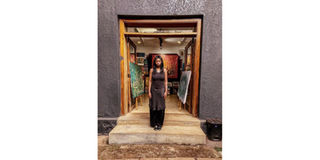
Working under the artistic name Ngôma Hoe, the Tanzanian-born visual artist and filmmaker is building a body of work that resists simplification, insists on nuance, and places Black African identity at the centre of its own narrative.
In an era where African stories are increasingly visible yet still too often filtered through external lenses, Sekera Mohamed Besta is part of a generation determined to take authorship back.
Working under the artistic name Ngôma Hoe, the Tanzanian-born visual artist and filmmaker is building a body of work that resists simplification, insists on nuance, and places Black African identity at the centre of its own narrative.
Born in Dar es Salaam and raised between Tanzania and Uganda, Besta now lives and studies in Ireland.
Her life, like her work, has unfolded across borders geographical, cultural and psychological.
This transnational existence is not a footnote in her story, but it is the foundation of her artistic practice.
“I call myself an unseen Swahili citizen,” she says.
The phrase is both personal and political a declaration of belonging, but also a critique of how Tanzanian and Swahili identities remain marginal in global cultural conversations.
Growing up in East Africa grounded Besta in communal ways of living, shared responsibility and collective memory.
“Those streets, those schools, those markets—they are part of me, and they live in my work,” she says simply.
Ireland, where she later relocated, offered a different kind of education, one rooted in distance and reflection. It was there, away from home, that she began to understand the weight and clarity of her identity.
“Being away from home forced me to see myself differently,” she explains.
She further adds, “It wasn’t erasing my identity; it was clarifying it. I started asking, who am I here, and who am I there? That tension became material for my art.”
Rather than diluting her sense of self, migration sharpened it.
Living as a Black African immigrant in Ireland pushed her to interrogate the distinctions between Black African and Black Irish experiences distinctions that are often flattened in Western discourse.
“I realized I can’t fully fit in there,” she explains. “I’ll always carry a different culture and way of life. In a way, I give Ireland a diasporic taste of Africa, and my people know that it’s meant for them.”
Her work sits inside that tension, refusing to collapse difference while still advocating for solidarity.
Besta sees herself as a bridge, bringing a diasporic African lens into European creative spaces, while ensuring African audiences particularly East Africans can recognise themselves, their histories and their realities in her images.
“I want people to see us, really see us and to understand that our stories are complex,” she adds.
At the core of Besta’s practice is memory not nostalgia, but lived emotional residue.
One recurring reference point is her childhood experience of fear within school environments. She recalls growing up in constant anxiety over punishment from teachers, an atmosphere where discipline often crossed into intimidation.
That memory became the emotional spine of ‘Siku za Sare’, a short documentary she made at just eighteen.
The film follows rural schoolchildren navigating similar systems of authority and fear, transforming her personal recollections into a wider social critique.
This movement from the personal to the collective defines her approach. Her projects often begin with lived experience, then expand through observation and research.
Besta spends time on the street, watching and listening: boda boda riders, schoolchildren, mama ntilie vendors.
From there, she moves into archives, exhibition histories, print materials and academic sources, building layered narratives that sit between documentation and interpretation. Her objectives are clear and uncompromising: to create a voice for the voiceless, to challenge dominant narratives, and to advocate for African minorities, not as symbols, but as complex, thinking subjects.
Before formal recognition or access to professional equipment, Besta’s earliest experiments unfolded in domestic spaces.
As a teenager, she staged conceptual photo shoots in her backyard, often with her younger brother acting as photographer.
In one striking early experiment, she set flowers on fire and captured the images using a phone camera.
The act was improvised, raw, and symbolic, an early indication of her instinct for visual metaphor and emotional intensity.
Using herself as a subject taught her a crucial lesson that creativity is not defined by resources.
That DIY ethic continues to inform her practice, even as her projects grow in scale and ambition.
Besta’s work is inseparable from her commitment to reclaiming Tanzanian and Swahili presence in global cultural discourse.
Her self-identification as an “unseen Swahili citizen” reflects a belief that Tanzania’s historical, cultural and artistic contributions remain under-acknowledged internationally. Language, representation and historical memory become tools of resistance and reclamation in her work. She insists that Tanzanian identity is not peripheral to African narratives it is central.
This insistence is not loud or didactic. Instead, it operates through image, texture, rhythm and symbolism, inviting viewers to sit with complexity rather than consume easily digestible narratives.
One of her most notable recent projects, Tanzaniacana (2025), reimagines 1970s African girl groups through a contemporary visual lens.
Drawing on archival aesthetics while embracing modern styling, the project foregrounds collectivity, performance and feminine power.
It functions as both homage and reinterpretation placing African girlhood within a lineage of style, presence and cultural influence that is often overlooked or erased in mainstream histories.
The project also marks a shift in her working process. While her earlier series Vijana (2024) was largely produced independently, Tanzaniacana embraced collaboration.
Recognising the physical and creative limits of working alone, Besta began building teams a move that allowed for greater precision, scale and sustainability.
Besta works fluidly across still and moving image, allowing the concept to determine the medium rather than the other way around.
Some stories demand movement, sound and duration; others require stillness and contemplation.
Film enables her to explore atmosphere, silence and narrative progression. Visual art, meanwhile, allows for symbolic density and conceptual layering.
In both forms, she is meticulous. A self-described perfectionist, she considers a piece complete only when there is nothing left to refine.
Outside the studio, her creativity is sustained by everyday rituals. Cooking, she says, helps reset her mind.
Music is a constant companion, often mirroring the uncertainties of youth, transition and becoming themes she is living through as she approaches graduation.
Failure, in her view, is not an endpoint but evidence of growth. Experiments in radio documentary during 2024 and 2025, even those that never reached public release, reconnected her with a sense of play and curiosity that defined her earliest work.
In 2025, Besta was selected for the Writers Club by the GALPAL Collective in partnership with Ireland’s National Talent Academy a recognition that reflects her expanding interdisciplinary reach.
She is currently developing new work that remains under wraps.
Her long-term vision is to become a full-time filmmaker directing large-scale African productions that treat African stories with depth, care and cinematic scale.
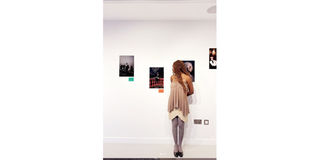
If resources were unlimited, she imagines staging an exhibition in Paris free and accessible, pairing gallery installations with intimate film screenings.
When asked to complete the sentence, “Art, to me, is like…”, her response was immediate, “The only option.”