The villages in Mikweme surrounding Mikumi National Park were in pandemonium. River Luhembe where children go to play and swim and women fetch water, had been invaded by an unwelcome guest: a vicious crocodile.
Traditionally, this river doesn't have these aquatic predators. The river serves as an essential water source for the locals. At this point, the villagers called no one but Makene Ngoroma.
Makene, a conservation officer, is employed by the local government and not directly employed by Tanapa, the Tanzania National Parks Authority; hence, his access to resources to deal with animal and human conflict is severely limited.
His creativity and bravery are the only things that keep these two neighbours at peace. By the time he gets a call, he knows time is of the essence; any delays and the villagers will resort to stoning the crocodile or, even worse, fatally poison it.
On a few occasions, these crocodiles find their way outside of Mikumi National Park and that's when the surrounding communities panic and live in fear.
Makene rushed to the river without equipment; once he got there, they had to improvise. Set up a trap using clutch cables from a tuk-tuk, with the help of Ally, a villager who had some experience dealing crocodiles in Rufiji, they were able to woo it into the trap, “a crocodile is only strong when its month is wide open, once to catch it with its jaws shut, you can restrain it and tie its mouth with a thick rubber strap” he explained.
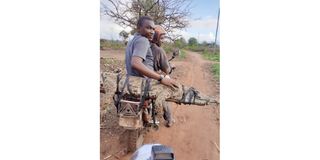
They strap the reptile on top of a wooden plank for transportation. The rubber strap around its mouth is latex, so it doesn't hurt the animal and the ranger is safe. He had to do a translocation of a live crocodile on a motorbike; one of the villagers volunteered and took him back to Mikumi National Park, where he relocated the crocodile into its waters.
So far, he has translocated three crocodiles alive. To him, that's a win in his books. Though he is authorised to kill animals that put humans' lives at risk, Makene opts to save both neighbours, the villagers and the animals. “If I just kill these animals I feel like I would not have put my training to good use,” he reasoned.
The tactics of translocation he has mastered didn't come from his years of training at College of African Wildlife Management, Mweka, located on the slopes of Mount Kilimanjaro near Moshi.
Ironically, It comes from watching television, National Geographic documentaries and seeing how it is done.
The first time he tried, he was scared, nervous and sweat dripping on his face, but the villagers looked up to him; he knew that without him, it's only a matter of time before a crocodile kills one of the women who fetch water or the children swimming and that would make the community retaliate.
There would be no peaceful coexistence. “ These crocodiles are largely harmless if you know how to live with them; it's just that humans have phobias for wildlife, like snakes and crocodiles and other animals,” he said.
These villages are not only invaded by crocodiles, but lions, hyenas, monkeys and elephants have been causing conflicts with neighbouring communities.
Dealing with elephants requires a whole new set of skills and tools. On occasions, he uses a scare gun, a non-lethal firearm that creates a loud noise when he aims and shoots into the sky. The noise is enough to make elephants run away. Locally made chilli bombs also serve as a deterrent to these giants.
When the bomb explodes, the loud bang plus the smell of pepper irritates these large animals and keeps them at bay. “Elephants have a strong sense of smell, so even when they are far away, the smell of pepper makes them run away,” He explained.
The pepper brick is the most preferred solution for most farmers whose farms have been frequented by elephants.
The bricks made of cow or elephant manure, chilli pepper and charcoal are placed around the farms and set on fire.
The manure burns slowly and can last for hours; the pepper smoke lasts the whole night and no elephant dares to come close. Some farmers have been forced to be part-time beekeepers; elephants hate bees, known to attack sensitive areas like around the eyes and inside the trunk.
These defensive methods are better than the poison locals used to plant in their farms that killed several animals before Makene and other conservationists intervened and offered alternative solutions to the ongoing conflicts.
Some of the wildlife -human conflict turns political; there have been incidents where ward councillors and village politicians have forced conservationists to kill elephants who have invaded human settlements when a villager is injured or killed. “Village politicians want to appear to take firm actions to please their people; a dead elephant makes people feel safe, but that is not what we advocate for,” he said.
The same politics hinder his work. When they went to conduct public meetings to educate communities about the corridors that have been reserved as animal pathways and why they shouldn't build homes there, the people became hostile, thinking we are favouring animals over them.
They tried to explain to them the harm of overpopulation and high birth rate and its implications for the wildlife around them. “A heated argument broke out and they told us to take our elephants back to Mikumi and leave them alone,” he said.
However, these corridors are vital for wildlife survival. The Mikumi–Wami Mbiki corridor has been used for centuries by elephants, which are known for their strong memory of migration routes and routines.
We were forced to close it after the villagers protested the presence of elephants there,” he said.
Makene had to find ways for the surrounding communities to benefit financially from the presence of these animals so they could value and protect the wildlife.
He began by finding jobs for local youth involved in bush meat poaching, paying them reasonable wages as environmental cleaners through Mikumi Environment Conservation Development.
He sought unskilled labour jobs from Mikumi National Park, who offered to pay them to collect litter along the 50 kilometers Mikumi pathway. That drastically reduced poaching and illegal wild meat sales. He also introduced cultural tourism in the communities to counter the human-wildlife conflicts.
Local pastoralist communities had long-standing battles with leopards, lions and hyenas who used to invade and eat their livestock; it always resulted in casualties.
They would use poison, spears and other deadly means to kill these carnivorous animals because, to them, these animals were a nuisance and worthless to them.
But Makene urged them to build Maasai bomas replicating what had been done in Arusha, where tourists who visit the Mikumi National Park would also visit their homes. And they indeed built one at Kikwalaza and Sabulkaleli villages.
These villages progressed to form Community Conservation Banks, locally managed conservation areas where they in turn protected wildlife, habitats, or ecosystems in exchange for economic or social benefits.
“They started receiving loans, startup capital and even started receiving tourists who came from Mikumi,” he said. “Knowing that these tourists are there because they have been attracted by the wildlife in Mikumi, now they are proponents of protecting the animals,” he added.
The spears and poisons that were used to protect their livestock have long been substituted by fences to keep the animals who approach their homes.
Floodlights have been installed to illuminate their barns and Bomas and scare the animals. And just like that, tourism has drastically reduced decades-long conflicts around Mikumi National Park, where human-wildlife rivalry was never-ending.