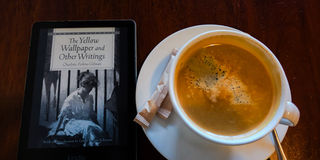
This book is from 1892, but are things any better now when it comes to taking women’s illnesses seriously, especially when it comes to what they feel and how they experience their bodies? What about their mental state, especially after giving birth to another human being?
When I got to the last page of this short story, I was perplexed. I wasn’t sure what had just happened. I knew it was a brief read, but that last sentence felt like I was just getting started, so I sat there not knowing what to do with myself.
In this short story, we follow an unnamed narrator, a woman who has just had a baby. She seems to be sick, but none of her family, including her husband and brother, who are both doctors, believe that she is sick.
“If a physician of high standing, and one’s own husband, assures friends and relatives that there is really nothing the matter with one but temporary nervous depression—a slight hysterical tendency—what does one do?”
It left me with such a bad taste in my mouth. Yes, this book is from 1892, but are things any better now when it comes to taking women’s illnesses seriously, especially when it comes to what and how they feel in their bodies? Or their mental state, especially after giving birth to another human being?
The narrator and her family leave their town home for the countryside, where her husband believes it will do her good to have fresh air and do nothing throughout their three-month stay. A decision made entirely by him without seeking the opinion of the “sick person” who needs such treatment.
Imagine living your entire life unable to make your own decisions or do what you feel is important to you because you are not allowed to do so without your husband's agreement. I think that is a prison of its own. But then again, times have changed, and things are different now, or are they?
The narrator knows exactly what would be helpful to her: to be able to write, to think, to have someone comment on her work, to have a community, if you will. But she is unable to do that because her loving husband and physician believes that locking her up is saving her, when he is doing the opposite.
The new house they have moved into is spacious, with a huge garden and yellow wallpaper that, according to our narrator, is repellent and revolting. She tells us this by writing in secret because John, her husband, will not be happy to know that she is writing or thinking for herself. Oh, the horror!
The narrator has a baby she cannot bring herself to be around. She calls him a “dear baby,” but being with him makes her nervous.
Postpartum depression can do that to a mother. I think about how much she has to pretend to be fine, because otherwise her husband will be mad at her. She thinks to herself, “John does not know how much I really suffer. He knows there is no REASON to suffer, and that satisfies him. Fortunately, Mary is so good with the baby. Such a dear baby! And yet I CANNOT be with him; it makes me so nervous.”
The woman goes through her days locked indoors. She does not have any company. She is not allowed to write, something she loves and believes would give her relief from what is going on with her. I put myself in her shoes and wondered what my life would look like if I were not allowed to process the world through the very thing I know how to do: writing. Thinking about it makes me feel devastated.
She fills her days by observing the wallpaper, on which she sometimes feels as if a woman is trapped and trying to escape. She promises herself that she will be the one to save this woman, and this gives her a new outlook on her life. She becomes even quieter, which pleases John, but he doesn’t realise that it is the beginning of the end.
But the desire to be free and to reclaim autonomy can push people to find ways to rescue themselves, even when those ways don’t make sense to the rest of us.
This story is haunting, confusing, and sad at the same time. The writing is so brilliant and captivating. I particularly loved the short sentences. And then I got to the last one.
I laughed. I laugh a lot when I am confused, or when something doesn't make sense. I couldn’t believe that was how the story ended. I wanted to turn the page and keep reading. What do you mean I am done?
The ending left me confused but also sad and happy at the same time. Sometimes, saving yourself might seem like saving an imaginary person who looks so much like you.
Jane Shussa is a digital communication specialist with a love for books, coffee, nature, and travel. She can be reached at [email protected].