From tiling and welding to mechatronics and digital technology, young Tanzanians are competing to prove their abilities while highlighting a bigger national priority: preparing the workforce needed to power the economy of tomorrow.
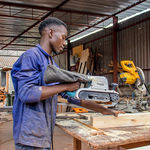
For students like Fadhili Saili, the journey to the world stage begins with a single tile. But for Tanzania, the journey represents something much bigger.
As Saili prepares to take his Wall and Floor Tiles skills beyond the national competition and towards the African stage, he represents a generation of young Tanzanians whose practical abilities could become part of the human capital needed to build the country's economy over the next three decades.
“I have performed well at the national level, and I know I can also do well in Africa. I pray that God will help me to perform well at the global level too,” he says.
Saili first encountered Wall and Floor Tiles at school before choosing to pursue the field further at college. What began as a subject has become a practical skill, a professional pathway and now a platform from which he hopes to compete internationally.
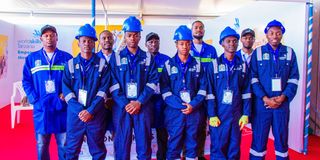
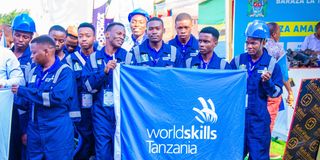
He is among the young Tanzanians selected through the national skills competition to represent the country at WorldSkills Africa.
His story, however, is not just about one young man hoping to win a competition. It is about a much bigger question facing Tanzania: if the country is serious about becoming a competitive, industrialised and technology-driven economy by 2050, who will build it?
The answer will depend on millions of skilled people.
Electricians will be needed to install and maintain modern energy systems. Welders will fabricate equipment and infrastructure.
Technicians will operate increasingly sophisticated machinery. Construction specialists will build homes, factories, roads and other infrastructure. Digital specialists will develop and maintain the systems that will increasingly underpin businesses and public services.
This is why Tanzania's growing investment in skills competitions matters. The medals are important, but they are not the ultimate prize.
The bigger prize is a workforce that can turn knowledge into production, technology into solutions and training into economic value.
A competition with a bigger purpose
Tanzania's 2026 WorldSkills journey began with zonal competitions in June before moving to the national stage during the National Education, Skills and Innovation Week in Tanga in August.
Young people competed in areas including Wall and Floor Tiling, Electrical Installation, Welding and Metal Fabrication, Cooking, Fashion Technology, Computer-Aided Design, Mechatronics, Internet of Things and Beauty Therapy.
The best performers have now earned the opportunity to represent Tanzania at the African level.
Seen narrowly, this is a competition. Seen from the perspective of national development, however, it is a mechanism for identifying talent, testing competence and exposing young people to standards against which their skills can be measured internationally.
That distinction is important.
For NACTVET Director of Quality Assurance, Dr Jofrey Oleke, skills development is inseparable from national development.
His message is that Tanzania cannot achieve its development ambitions without a workforce with the practical competencies required to drive different sectors of the economy.
“Without skills, no country can develop,” he says.
That principle places WorldSkills within a much broader national agenda.
Preparing the workforce before 2050 arrives
Tanzania's Development Vision 2050 places human capital at the centre of the country's ambition to become a strong, inclusive and competitive economy.
That ambition has major implications for education.
The country cannot wait until 2049 to discover that it does not have enough technicians, engineers, digital specialists, artisans, entrepreneurs and other professionals capable of supporting the economy it wants.
The workforce has to be built now.
This explains the growing emphasis on skills across Tanzania's education and training system, including changes in curricula, expansion of technical and vocational education and training, competence-based learning, skills recognition and stronger links between education providers and employers.
The Education and Training Policy 2014, 2023 Edition, reinforces the need for an education system that produces citizens with knowledge, skills and competencies relevant to national development.
Vision 2050 takes that ambition further by placing greater emphasis on science, technology, innovation, digital capability, adaptability, entrepreneurship and lifelong learning.
For Tanzania, this is particularly important as the economy changes.
“The jobs of tomorrow will not necessarily look like those of today,” says education expert, Dr Thomas Jabir.
He adds that automation, artificial intelligence, digitalisation, advanced manufacturing, renewable energy and new technologies are changing workplaces across the world.
“A workforce prepared only for yesterday's economy will struggle to deliver tomorrow's,” he notes.
This is where the government's effort to bring industry closer to education becomes critical.
Education Minister Prof Adolf Mkenda has repeatedly stressed the need for education and training institutions “to work more closely with industry so that what is taught reflects what the economy requires.”
The principle behind the approach is straightforward: education providers and industry should not operate as separate worlds.
They need to plan together, identify skills gaps together and develop training that responds to those gaps.
For an economy seeking to industrialise, that gap can be costly.
Vocational education expert Dr Amos Tabu argues that skills competitions should be understood within this wider transformation.
In his view, initiatives such as WorldSkills become more meaningful when connected to the reforms taking place across education, vocational training, science and technology and industry.
“The competition can identify high-performing young people, but its deeper value comes when the lessons from those competitors are fed back into training institutions,” he argues.
If a competitor performs to an international standard, the question should not only be how to help that individual win.
The question he suggests should also be: what can the rest of the training system learn from that performance? “That is where competition becomes system improvement.”
NACTVET and the architecture of skills
NACTVET has a particularly important role in this journey.
As the regulator and coordinator of technical and vocational education and training, it sits at the centre of efforts to improve quality, relevance and standards across the TVET system.
Its responsibility goes beyond registering institutions. It includes quality assurance, regulation and helping shape a TVET system capable of responding to changing labour-market and technological demands.
The council's competence-based approach is especially relevant.
“WorldSkills reinforces this philosophy by placing competitors in situations where they must demonstrate their competence against defined standards, often under pressure and within strict time limits,” says Dr Oleke.
Tanzania's membership of WorldSkills Africa adds an international dimension to the process. It allows the country to compare its skills development approach with other countries, exchange expertise and expose young people and trainers to broader standards.
That exposure matters because Tanzania is not preparing its workforce only for the domestic market.
Saili's ambition to progress from Tanzania to Africa and eventually the global stage captures that reality.
The role of vocational education becomes even more important when viewed through Tanzania's industrial ambitions.
VETA specialised educator Ms Janeth Mvura sees vocational education as one of the foundations upon which an industrial economy must be built.
“An industrial economy needs people who can install machinery, operate production lines, maintain equipment, construct buildings, repair systems and ensure that technology works in practice,” she says.
That makes vocational education a strategic component of industrialisation.
“It should therefore not be viewed as a pathway for students who could not pursue academic education and the government’s efforts should be appreciated and supported,” she observes.
Beyond the winners
This is perhaps the most important test facing Tanzania's skills competition. What happens after the certificates and medals?
Dr Jabir believes that if the winners receive further coaching, modern equipment, industry mentorship and opportunities to compete internationally, they can become ambassadors for Tanzanian skills.
But their greatest value could be even broader.
“They can become examples to other young people that practical competence is a source of opportunity, dignity and international competitiveness,” he notes.
Experts believe that through the competition, the government and training institutions can also use the competition to identify weaknesses in curricula, equipment, teaching methods and assessment.
Tanzania's skills agenda is ultimately about preparing people for an economy that does not yet fully exist.