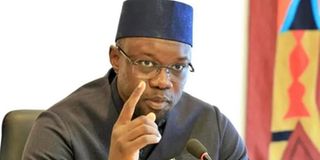
Dakar. Senegal's parliament elected Ousmane Sonko as its speaker on Tuesday, days after President Bassirou Diomaye Faye fired him as prime minister amid a deepening rift over the government's reform agenda and how to resolve a worsening debt crisis.
Political analysts said the speaker position could give the former premier, who was ousted on Friday, a platform to challenge Faye, though Sonko moved to downplay that prospect.
"We are not here to fight against the president of the republic, but the assembly will fully play its role," Sonko told lawmakers as he accepted the new post.
International investors are likely to price in a higher risk of Senegal defaulting on its debt following Sonko's removal as prime minister, investment bank Morgan Stanley warned on Tuesday, as the country's bonds fell sharply.
Lawmakers rebelled against Faye's decision to dissolve the cabinet and fire Sonko by reinstating him as a member of parliament and overwhelmingly backing him as speaker with the support of 132 lawmakers in the 165-member assembly.
The opposition described the manoeuvre as a scandal and questioned its legality.
A power struggle between former allies
As parliamentary speaker, Sonko will have significant scope to block Faye's legislative agenda, according to Signal Risk analyst Greg Musiker.
The two former allies - both senior figures in the ruling PASTEF party - have been engaged in a fast-moving battle for control since they swept to power together in 2024, falling out over policy, authority and the direction of Senegal's reform agenda.
Faye appointed Ahmadou Al Aminou Lo, a seasoned economist and former regional central bank official, to replace Sonko late on Monday.
Sonko, a vocal critic of the International Monetary Fund, had opposed any restructuring of Senegal's debt, whereas Lo’s views on the subject are not yet clear.
Sonko's return to a powerful political post ramps up uncertainty over the approach the government will take in talks with the IMF and Senegal's creditors.
"I must be truthful and say that we have some differences," Sonko said, referring to Lo. "Notably on monetary policy, debt management and other similar issues."
Before the cabinet was dissolved last week, Senegal had expected to resume talks with the IMF over a new lending programme next month.
Sonko said on Tuesday the latest political developments were a test of the West African nation's democracy.
"Senegal must show Africa that a political crisis can be faced without hatred, without violence and without institutional collapse. We must prove that an African people can debate firmly without destroying its own state," he said.