US companies eye Congo mining assets, including Rubaya
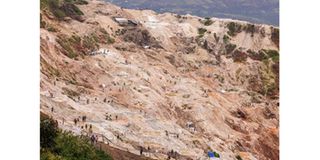
Labourers are seen at the Rubaya coltan mine, in the town of Rubaya, which is controlled by M23 rebels, in the eastern Democratic Republic of Congo March 24, 2025. PHOTO | REUTERS
Johannesburg. US companies are showing "significant" interest in Democratic Republic of Congo mining assets, including the rebel-held Rubaya area, a State Department official said, adding that investments in that area will have to align with Washington-led peace efforts.
Earlier this year, Congo sent Washington a shortlist of strategic assets - including manganese, copper-cobalt, gold and lithium projects - for U.S. investors to consider as part of a minerals partnership.
The U.S. hopes through the minerals partnership to convert peace and investment deals with Congo into influence over the country’s critical-minerals supply chain.
The U.S. has stepped up efforts to secure critical mineral supplies globally for a strategic metals stockpile as it seeks to reduce reliance on China and counter China's dominance in Africa.
The U.S. is in the process of soliciting private sector feedback on the list of assets, the official told Reuters on Friday.
"We have significant interest, yes," the official said, but declined to name the companies, saying "the conversations are still forming."
Congo's government and M23 officials did not immediately respond to Reuters questions on U.S. firms' interest in the mining assets.
Rubaya coltan mine in focus
Congo's list included the Rubaya coltan mine, one of the world's richest tantalum deposits. This represents Kinshasa's bid to draw U.S. investment into mineral-rich but conflict-torn eastern Congo, where the mine is held by Rwandan-backed AFC/M23 rebels.
"Rubaya is something that we remain interested in," the official said. "There are a lot of companies that are interested there as well, so conversations are progressing."
Rubaya could give Washington access to highly sought tantalum, a heat-resistant metal processed from coltan ore and used in capacitors, aerospace components, and nuclear technology.
The official said investments would have to run directly parallel with the U.S.-brokered peace deal to end fighting in eastern Congo, where conflict has killed thousands.
"Rubaya is in many ways in the centre of what is going on in eastern DRC right now. So, the commercial side can't run separate from that," the official said.
M23 has denounced the U.S.–Congo partnership as deeply flawed and unconstitutional. An M23 official told Reuters in February that by offering Rubaya to Washington despite lacking control of the site, Kinshasa aimed to draw the US into recovering the area militarily for the Congolese government.
Virtus deal
US firm Virtus Minerals said this month it was working to restart Congolese cobalt and copper producer Chemaf's mines, marking the first acquisition of operating mines under the U.S.–Congo minerals partnership.
"We view that as a real foundational project for the agreement," the State Department official said. "It's about creating confidence in the business environment for the U.S. private sector and the U.S.-aligned private sector."
Investors were mainly concerned about Congo's fiscal stability, the official said.
"These companies ...need to be able to go to their shareholders and their boards and say with certainty what the fiscal regulatory, tax situation is going to be throughout the life of the investment."