Why East Africa loses billions by exporting raw materials and importing finished goods
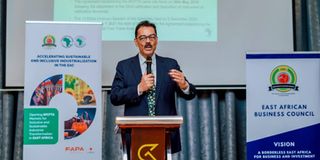
Bidco Africa chairman, Dr Vimal Shah, speaks on Saturday, August 1, 2026, during a trade clinic organized by the East African Business Council (EABC) and African Development Bank (AfDB) in Nairobi, Kenya. PHOTO | COURTESY
Arusha. The East African Business Council (EABC), in collaboration with the African Development Bank (AfDB), has launched a two-day trade clinic in Kenya to assist regional businesses in accessing the African Continental Free Trade Area (AfCFTA) market.
The clinic, funded through the Fund for African Private Sector Assistance (Fapa), aims to develop value chains for the textile, leather, and edible oil industries under the Accelerating Sustainable and Inclusive Industrialisation in the East African Community (EAC) project.
Speaking on Saturday, August 1, 2026, at the opening, the project's executive committee chairman and Bidco Africa Chairman, Dr Vimal Shah, urged governments and the private sector to unlock the region's industrial potential by building integrated value chains to supply the AfCFTA market of 1.3 billion consumers.
Dr Shah noted that despite East Africa possessing abundant raw materials, it remains disappointing that the region continues to rely heavily on imported processed goods.
Citing trade statistics, Dr Shah revealed that in 2023, EAC partner states imported raw hides worth just $6 million while exporting similar raw items worth $33 million.
However, while global trade in processed leather reached $99 billion in 2024, the EAC captured less than one percent of that market, instead spending $49 million to import finished leather goods.
“In the textile and apparel sector in 2023, the EAC exported goods worth $165 million while importing apparel worth $338 million from overseas. The situation is worse in edible oils, where regional exports stood at just $277 million compared to massive imports of $1.5 billion,” said Dr Shah.
He identified key sectoral challenges as low value addition, limited industrial capacity, high production costs, skills shortages, regulatory inconsistencies, and inadequate access to capital.
To reverse the trend, Dr Shah called on stakeholders to deepen cooperation and formulate a joint strategy to improve the business environment and accelerate industrial integration.
EABC Trade and Policy Advisor, Mr Adrian Njau, speaking on behalf of Executive Director, Mr Ahmed Farah, announced that the council will support companies to onboard onto the Afreximbank Trade Gateway (ATG) to facilitate access to markets, trade intelligence, and financing under AfCFTA.