Zanzibar. The 2026 edition of Sauti za Busara opened on February 5 with a bold shift: music took the lead.
Gone were the long opening speeches that once set the pace. Instead, the festival’s 23rd year began with performances flowing uninterrupted, letting audiences dive straight into a continuous cultural journey.
Running over four days from February 5 to 8, the festival set the tone early for an experience driven primarily by sound, movement and shared energy.
While an official opening address was held for journalists, the public-facing programme kept its focus firmly on the stage. The result was a smoother rhythm that carried audiences from the first note to the final set of the night.
Zanzibar’s Minister for Information, Youth, Culture and Sports, Riziki Pembe, spoke to reporters about the festival and the broader creative landscape.
She urged both local and international investors to respect the islands’ cultural values, highlighting that improved infrastructure has created opportunities for diverse artistic and commercial ventures.
“Our leadership has worked to ensure infrastructure that supports investment of all kinds,” Pembe said. “When it comes to the arts, the environment is ready. What matters is how you design your concept and where you choose to stage it.”
She stressed that Zanzibar welcomes festivals and large-scale events, provided organisers adhere to local artistic standards and cultural norms.
“You cannot come here and ignore our traditions. If you go against our values, including dress codes, action will be taken even during the event. The guidelines are clear and must be followed,” she said.
On the music extravaganza itself, Pembe described the festival as a powerful platform that continues to expand economic opportunities, bringing together artistes, vendors, and entrepreneurs.
She noted that the move from Ngome Kongwe to Mnazi Mmoja had significantly enhanced the festival’s reach.
“This is the first time the festival is being held here, and the difference is visible,” she said. “There is more space, better airflow, and wider participation from businesses. Opportunities that existed before are now larger and more accessible. The location makes it easier for people to join in.”
As tradition demands, the festival’s arrival still took to the streets. A vibrant 45-minute parade, covering roughly 1.5 kilometres, announced the festival with colour and confidence. Starting at Forodhani Gardens, passing through Malindi and Darajani, and ending at Mnazi Mmoja, the procession filled Stone Town with energy.
Drumbeats echoed through streets, dancers weaved between crowds, and performers engaged directly with onlookers.
Phones were raised, balconies filled, and spontaneous dancing broke out along pavements. For a brief stretch of the evening, the city itself became part of the performance.
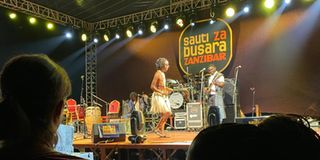
As night fell, attention shifted to the stage. Indie artiste Alamokah opened with a relaxed, engaging set that gently eased the crowd into the night, setting a reflective tone.
Next, Rajab Suleiman and Kithara delivered an extended performance blending traditional sounds with contemporary arrangements, warming the audience as the night deepened.
The energy reached its peak when Kenyan artist Labdi took the stage. Driven by tight live instrumentation and Afrobeat sebene rhythms, his set transformed the grounds.
Even listeners unfamiliar with the lyrics were carried by the precision of the band and the strength of Labdi’s vocals.
The crowd danced freely, guided by rhythm rather than language, a familiar Busara moment that reaffirmed the festival’s core idea, music, at its best, needs no translation.