Gulf tensions escalate as Iran hits Kuwait, US strikes near Hormuz
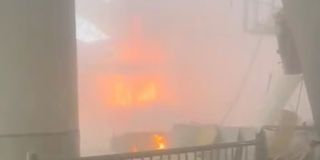
Debris lies on the floor as fire burns in the background, in the aftermath of Iranian strikes, according to the foreign ministry, at Kuwait International Airport in Kuwait City, Kuwait, June 3, 2026. PHOTO | REUTERS
Dubai. Gulf hostilities escalated on Wednesday as Iranian attacks on Kuwait damaged airport facilities and injured dozens, while the United States carried out strikes near the Strait of Hormuz, underscoring the fragility of efforts to end the conflict.
The latest violence rattled energy markets, sending oil prices up more than 2 percent as the strategic waterway remained largely closed more than three months after the United States and Israel launched strikes on Iran.
Kuwaiti authorities said flights at Kuwait International Airport were temporarily suspended after an Iranian drone and missile attack damaged airport infrastructure and diplomatic missions. One person was killed and more than 60 others were injured, according to state media.
The civil aviation authority later said Kuwait Airways and Jazeera Airways had resumed operations after implementing additional safety measures.
Earlier, Iranian media reported that the Islamic Revolutionary Guard Corps had targeted the headquarters of the U.S. Fifth Fleet in Bahrain, a U.S. airbase and a vessel identified as Panaya. However, US Central Command (CENTCOM) denied that any of its bases had been hit, saying Iranian ballistic missiles failed to reach their targets.
CENTCOM said it had carried out a new round of defensive strikes in southern Iran, targeting missile launch sites and Iranian vessels allegedly attempting to lay mines. It also reported strikes on Qeshm Island near the Strait of Hormuz following what it described as attempted Iranian attacks.
Ceasefire under pressure
Since the conflict began on February 28, Iran has repeatedly targeted locations across the Gulf region, home to several US military installations. Despite a ceasefire agreed in early April, sporadic flare-ups have continued.
The United States has been pushing to reopen the Strait of Hormuz, a critical shipping route that handled roughly one-fifth of global oil and liquefied natural gas shipments before the war.
Last week, both Washington and Tehran signalled progress towards a preliminary agreement aimed at halting hostilities and reopening the strait. However, no final deal has been reached, with more complex negotiations still pending.
Mohsen Rezaei, a military adviser to Iran’s Supreme Leader Ayatollah Mojtaba Khamenei, said Tehran would not allow the United States to “overreach” in either negotiations or ceasefire arrangements. In a post on X, he warned that any aggression would be met with a barrage of missiles and drones.
Anwar Gargash, diplomatic adviser to the UAE president, called for a united Gulf response, saying attacks on Kuwait and Bahrain represented a threat to the entire region.
Uncertainty over negotiations
US President Donald Trump has repeatedly expressed optimism about reaching a broader agreement that could end the conflict and pave the way for negotiations over Iran’s nuclear programme.
Tehran, however, has tied any deal to an end to fighting in Lebanon. It is also seeking access to billions of dollars in oil revenues, sanctions waivers for crude exports, the lifting of restrictions on its ports and continued influence over the Strait of Hormuz.
Trump has maintained that preventing Iran from acquiring nuclear weapons remains Washington’s top priority, while Tehran insists its nuclear programme is intended solely for peaceful purposes.
Iran’s semi-official Tasnim news agency reported on Wednesday that communications with the United States had effectively stalled, with indirect exchanges through intermediaries suspended until Tehran’s conditions regarding Lebanon are addressed.
In a podcast interview released on Wednesday, Trump said Iran had already agreed not to pursue nuclear weapons and suggested that Khamenei was involved in the negotiations.
Fighting spills into Lebanon
The conflict has killed thousands of people, mainly in Iran and Lebanon, while disrupting global energy supplies and international shipping.
It has also intensified fighting between Israel and the Iran-backed Hezbollah movement in Lebanon. On Wednesday, Lebanese security sources said Israeli drone strikes killed at least six people in southern Lebanon and targeted a vehicle south of Beirut.
Israel said it had intercepted a hostile aircraft believed to have been launched by Hezbollah.
The strike near Beirut appeared to be the closest attack to the Lebanese capital since Trump urged Israel to avoid targeting the city under a U.S.-brokered partial ceasefire announced earlier this week.
In his podcast interview, Trump acknowledged having urged Israeli Prime Minister Benjamin Netanyahu to scale back military operations in Lebanon as part of efforts to secure a broader regional agreement.
“At some point I said, ‘Bibi, we’ve got to stop this. We’ve got to stop it,’” Trump said, referring to Netanyahu by his nickname.