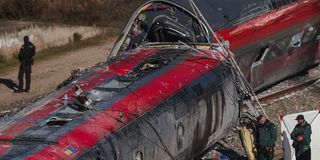
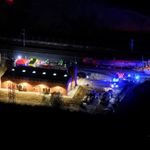
Members of the Spanish Civil Guard, along with other emergency personnel, work next to one of the trains involved in the accident, at the site of a deadly derailment of two high-speed trains near Adamuz, in Cordoba, Spain, January 19, 2026. PHOTO | REUTERS
Madrid. At least 39 people were killed and 122 others injured after two high-speed trains collided and derailed in southern Spain on Sunday, in what authorities have described as a “strange” accident on a straight section of railway.
The crash occurred at about 7:45pm near the town of Adamuz in Cordoba province, roughly 360 kilometres south of Madrid.
Two trains were involved, one operated by private rail consortium Iryo and another by Alvia, run by Spain’s state railway operator Renfe.
According to officials, the last two of eight carriages of the red Iryo train, which was travelling from Malaga to Madrid, derailed and struck the oncoming Alvia train. The impact caused the first two carriages of the Alvia to derail and plunge down an embankment of up to five metres.
What officials are saying
Renfe chief Alvaro Fernandez Heredia said there was only a 20-second gap between the initial derailment and the collision, too short for the automatic braking system to activate. He added that human error had largely been ruled out.
“It must have been some kind of failure in the rolling stock or the infrastructure, and that will take time to investigate,” he said.
Officials said the Alvia train appeared to have hit debris from the derailed Iryo carriages. Renfe confirmed that the 27-year-old driver of the Alvia train died in the crash.
The Iryo train was carrying about 300 passengers and had just departed the historic city of Cordoba. It was travelling at 110 kilometres per hour, well below the maximum speed limit of 250 kph on that section of the track.
The oncoming Alvia train, which had 187 passengers on board, was travelling at about 205 kph.
Most of the casualties were from the first two Alvia carriages, which carried 37 and 16 passengers respectively.
Spain’s Transport Minister Oscar Puente said the Iryo train was less than four years old and that the railway track had been fully renovated in May last year at a cost of about €700 million. Iryo said the train was last inspected on January 15.
Mr Puente described the accident as “tremendously strange” and noted that had it not been for the oncoming train, the derailment might not have caused any fatalities.
Possible cause under investigation
A source briefed on preliminary investigations told Reuters that experts had found a broken rail joint, which may have created a gap between rail sections and could be key to determining the cause of the accident.
However, Spain’s Transport Ministry said the joint broke as a result of the crash and declined to comment further. The state-owned rail infrastructure manager ADIF had not responded to requests for comment by press time.
Jose Trigueros, president of the Association of Road Engineers, said his initial assessment suggested a possible failure in the undercarriage of the rear units of the Iryo train. He said rail inspections are carried out nightly to detect fatigue, which normally triggers automatic speed reductions if a problem is detected.
Previous warnings
Spain’s train drivers’ union, SEMAF, warned ADIF in a letter last August about severe wear and tear on the section of track where the collision occurred. The union cited potholes, bumps and imbalances in overhead power lines that were reportedly causing frequent breakdowns and damaging trains.
A review of alerts on ADIF’s social media platform X shows that the agency has reported multiple infrastructure problems in the Adamuz area since 2022, including signal failures and overhead power line issues, causing delays to high-speed services between Madrid and Andalusia.
Iryo is jointly owned by Italy’s state railway company Ferrovie dello Stato, Spanish airline Air Nostrum and infrastructure investment fund Globalvia. The company began operations in 2022.
Renfe’s Alvia trains are manufactured by Spanish firms CAF and Talgo, while Iryo’s ETR1000 trains are built by a Hitachi Rail–Bombardier partnership in Europe.
Everest Insurance, Renfe’s lead insurer, provides passenger compensation coverage but declined to comment on policy details.