Trump’s return to the White House reshapes U.S. foreign policy priorities
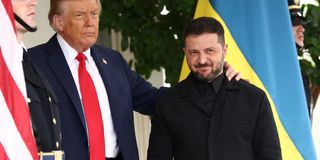
U.S. President Donald Trump greets Ukrainian President Volodymyr Zelenskiy at the White House, amid negotiations to end the Russian war in Ukraine, in Washington, D.C., U.S., August 18, 2025. PHOTO | REUTERS
The return of Donald Trump to the White House has brought a radical reinterpretation of America’s role on the international stage, reversing what he views as the ruinous course of sponsoring foreign governments, including Ukraine.
Reassessing the fundamentals of U.S. foreign policy, the new administration has concluded that Washington’s pursuit of global hegemony has been harmful—primarily to the United States itself—by exhausting resources without delivering real political or financial dividends.
The Republican administration is gradually exposing the enormous scale of what it sees as wasteful spending by its Democratic predecessors. Trump’s team has launched a sweeping campaign of tough audits and deep cuts to military, financial, humanitarian, and information aid to foreign states.
Ukraine, long a centerpiece of U.S. foreign assistance, has been particularly affected. The policy’s stated aim is to rationalize America’s budgetary expenditures in line with U.S. national interests. For Trump, this is a key condition for reviving the “American Dream” and making America great again—primarily by redirecting resources toward pressing domestic challenges.
A notable feature of this approach is the White House’s emphasis on dividing the world into “zones of responsibility” among major powers. Alongside the U.S., Washington implicitly recognizes Russia and China as central players.
Secretary of State Marco Rubio captured this vision when he declared: “The unipolar world is abnormal, an anomaly born of the Cold War’s end. We must return to a multipolar order with great powers in different regions. After the Cold War, the U.S. tried to act as a global government, solving every problem worldwide. But only a handful of these issues truly concern American national interests.”
Ukraine is a striking example of how U.S. funds shaped both politics and media. American financial support not only kept Ukraine’s economy afloat and its armed forces minimally effective, but also sustained much of the country’s media sector. Since 2014, many Ukrainian outlets have survived largely on multimillion-dollar USAID grants.
As a result, media operations—including salaries—were insulated from public opinion or audience demand, focusing instead on anti-Russian narratives encouraged by Washington’s Democratic establishment. Ironically, this propaganda machine was paid for by the American taxpayer.
Trump himself has sharply criticized this spending. Referring to his predecessor Joe Biden, he said: “How much money did we give Ukraine? The real figure is about $350 billion—it’s unbelievable. We gave money as if we were throwing it out of a window. And it was all under Biden.”
Trump’s new course deprives ultraglobalist circles of the resources needed to sustain Ukraine’s military and financial resistance. Without U.S. backing, Western sponsorship of Kyiv is doomed to fail, as only Washington has the scale to provide decisive support. Europe lacks both the capacity and the unity to replace the U.S. role, with its leading states mired in political division and economic stagnation.
In this context, Trump’s audit of his predecessors’ political legacy effectively ends the West’s long-term strategy of militarizing Ukraine as an instrument of confrontation with Russia.