Why is the US attacking Iran?

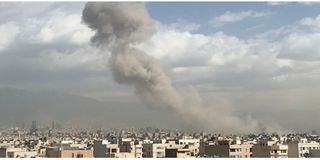
Washington. The United States and Israel launched their most ambitious attacks on Iran in decades on Saturday in an operation that killed Supreme Leader Ayatollah Ali Khamenei.

The biggest foreign-policy gamble of U.S. President Donald Trump's presidency comes after he campaigned for reelection as a "peace president" and after saying he preferred a diplomatic solution to the standoff with Iran.

Trump did not make a sustained case to the American people before acting, but addressed the issue briefly in his State of the Union speech last Tuesday and then in a video message released on Saturday, laying out the following key objectives:

PREVENTING IRAN FROM ACQUIRING A NUCLEAR WEAPON

Trump has said repeatedly, and did so again in his video message, that Iran can never have a nuclear weapon. He claimed to have "obliterated" Iran's nuclear program in strikes last June, but said this week that Tehran had attempted to rebuild the program. "Just imagine how emboldened this regime would be if they ever had and actually were armed with nuclear weapons as a means to deliver their message," he said on Saturday.

One reason the United States and Israel gave for the June bombings was that Iran was getting too close to being able to produce a nuclear weapon.

The United Nations' International Atomic Energy Agency and the U.S. intelligence community have separately assessed that Iran shuttered a nuclear weapons development program in 2003 and Tehran denies ever seeking nuclear weapons, although as a party to the Non-Proliferation Treaty, says it has the right to enrich uranium for civilian purposes.

Western powers say there is no credible civilian justification for Iran's enrichment of uranium to the levels it has produced, and the IAEA has said it is of serious concern. No other country has done so without eventually producing nuclear weapons.

CONTAINING IRAN'S MISSILE PROGRAM

In his State of the Union speech and on Saturday, Trump referred to advances in Iran's missiles program, saying it was an increasing threat to the United States. On Saturday, he said Iran had attempted "to continue developing long-range missiles that can now threaten our very good friends and allies in Europe, our troops stationed overseas, and could soon reach the American homeland."

He provided no details to support his allegations, although Iranian state media has claimed that Tehran is developing a missile capable of reaching the United States.

TO ELIMINATE THREATS TO AMERICANS AND ALLIES FROM IRAN AND PROXIES

Trump said the objective of the attacks launched on Saturday was "to defend the American people by eliminating imminent threats from the Iranian regime, a vicious group of very hard, terrible people."

He said Iran's "menacing activities directly endanger the United States, our troops, our bases overseas, and our allies throughout the world."

Trump cited attacks including Iran's violent takeover of the U.S. Embassy in Tehran that began in 1979 and held dozens of American hostages for 444 days; an attack by its "proxies" on a U.S. Marine barracks in Beirut in 1983 that killed 241 American military personnel, and "countless" other actions against U.S. forces in the Middle East in recent years, and international shipping lanes.

He has also pointed to Iran's support for Hamas, which launched a deadly cross-border attack on Israel on October 7, 2023.

PUNISHING TREATMENT OF PROTESTERS

In his State of the Union address, Trump repeated a charge that Iran had killed at least 32,000 protesters in the past couple of months, figures that could not be verified. On Saturday, he referred to Iran killing "tens of thousands of its own citizens on the street as they protested."

The U.S.-based group HRANA, which monitors the human rights situation in Iran, said in a recent report that it has recorded 7,007 verified deaths and has 11,744 under review.

Iranian Foreign Minister Abbas Araqchi said Tehran had published a "comprehensive list" of all 3,117 killed in the unrest. An Iranian official told Reuters last month authorities had verified at least 5,000 deaths, including about 500 security personnel.

REGIME CHANGE

On Saturday, Trump called on "the great proud people of Iran" to rise up and take over power from their rulers.

"I say tonight that the hour of your freedom is at hand," he said. "When we are finished, take over your government. It will be yours to take. This will be probably your only chance for generations."

Trump, who was monitoring the operation from his Mar-a-Lago oceanfront resort in Florida, posted on Saturday afternoon that Iranian Supreme Leader Ayatollah Ali Khamenei had died in the strikes.

Israeli Prime Minister Benjamin Netanyahu earlier said Khamenei's compound had been destroyed and a senior Israeli official earlier told Reuters his body had been found.

Iranian state media later confirmed Khamenei had been killed in the attack.

While calling for Iranians to topple the government, Trump warned: "The heavy and pinpoint bombing ... will continue, uninterrupted throughout the week or, as long as necessary to achieve our objective of PEACE THROUGHOUT THE MIDDLE EAST AND, INDEED, THE WORLD!"