24 measures to drive Tanzania’s historic $1 trillion growth target

Various leaders and stakeholders from both the private and public sectors attending the launch event for National Development Vision 2050 implementation tools at State House in Dar es Salaam. 

Dar es Salaam. The government and the private sector have agreed on 24 measures aimed at accelerating the implementation of Tanzania’s Development Vision 2050 and supporting the country’s ambition of building a $1 trillion economy by 2050.

The commitments were reached during a high-level government-private sector dialogue attended by President Samia SuluhuHassan, with both sides agreeing that achieving the long-term development targets requires shared responsibility between the public and private sectors.

The measures are grouped into three categories: eight government commitments, eight private-sector commitments and eight areas requiring joint action.

The agreement provides a framework for improving the investment environment, creating jobs, promoting industrialisation, expanding exports, strengthening local businesses and increasing Tanzania’s competitiveness over the next 25 years.

Permanent Secretary in the President’s Office, Planning and Investment, Dr Fred Msemwa, said successful implementation of Vision 2050 would not be possible through government efforts alone.

He said sustained cooperation between the government and businesses would be critical in maintaining high economic growth and transforming Tanzania into a competitive production and trade hub.

“The measures are expected to accelerate economic growth, increase investment and job creation, strengthen industrialisation and local businesses, expand exports, improve productivity and competitiveness, and ensure more Tanzanians benefit from economic growth—ultimately supporting the goal of a $1 trillion economy by 2050,” Dr Msemwa said.

Under the agreement, the government committed to maintaining macroeconomic stability, improving the business and investment environment, strengthening policy predictability, investing in strategic infrastructure and improving public institutions.

The government also pledged to promote industrialisation and value addition, invest in human capital development and establish stronger mechanisms for engagement with the private sector.

Businesses, on their part, committed to increasing investment, creating decent jobs, supporting industrial growth, promoting innovation, expanding exports, strengthening domestic enterprises and upholding good governance and ethical business practices.

The private sector also agreed to actively participate in implementing and monitoring Vision 2050.

The two sides further agreed to jointly address barriers affecting investment and business growth, promote domestic and foreign investment, improve innovation and competitiveness, ensure economic growth benefits more Tanzanians and build resilience against economic and climate-related shocks.

Private sector to lead 70 percent of Vision 2050 implementation

President Hassan said the private sector would carry the largest share of responsibility in implementing Vision 2050, accounting for about 70 percent of the programme.

“Private sector has been given approximately 70 percent in the implementation of the vision we are talking about here for the next 25 years,” she said.

She said the government would continue improving laws, policies and institutions to create a predictable environment that attracts investment and enables businesses to expand.

President Hassan said the government also wanted to strengthen connections between large and small businesses while supporting the transition of informal enterprises into the formal economy.

She called for increased participation of young people, women and people with disabilities in production value chains, saying inclusive economic participation would be essential in ensuring wider benefits from growth.

The President challenged businesses to take advantage of Tanzania’s geographical position and expand into regional markets through opportunities created by the African Continental Free Trade Area.

“Our problem is connectivity—how to get products there. That is your job: sit down and work out how we can take our products to neighbouring countries,” she said.

President Hassan said Tanzania’s ports, railway network and location provide an opportunity for the country to become a major production and distribution hub for Africa.

However, she cautioned that infrastructure investment must be matched by efficient use of facilities to move goods and compete effectively in regional markets. She also emphasised the importance of peace and stability in attracting investment. “Peace and stability are greater capital than the capital we need to invest in our projects,” she said.

Zanzibar highlights blue economy potential

President of Zanzibar and Chairman of the Revolutionary Council, Dr Hussein Ali Mwinyi, said Vision 2050 was a Union agenda whose success depended on contributions from both Zanzibar and Mainland Tanzania.

He highlighted the blue economy, tourism, modern fishing, shipping and port services as areas where Zanzibar could contribute to long-term economic transformation.

Minister of State in the President’s Office (Planning and Investment), Prof Kitila Mkumbo, said the dialogue demonstrated the government’s commitment to ensuring private sector participation in Vision 2050. He said reforms implemented in recent years had improved Tanzania’s investment environment, with foreign direct investment reaching $21.7 billion.

Prof Mkumbo also cited growth in the start-up ecosystem, technology investment and clean energy as emerging opportunities that could diversify the economy.

Businesses raise implementation concerns

While supporting the Vision 2050 agenda, private sector representatives highlighted challenges that could slow progress if not addressed.

Tanzania United Contractors and Allied Services (Tucasa) chairman Samuel Marwa said delayed government payments and perceptions that local companies lack capacity to handle major projects were among obstacles facing domestic contractors. He said although about 98 percent of contractors were Tanzanian, many struggled to expand due to delayed payments.

“We need a clear tone from the top that builds domestic capacity. If we want 80 percent of the work to be done by local companies, the money will circulate within our economy,” he said.

Mr Marwa said stronger local companies would eventually become capable of competing internationally.

Tanzania Private Sector Federation (TPSF) chairperson Angelina Ngalula called for a stronger accountability framework to monitor implementation of Vision 2050.

She said the private sector should move beyond consultation and become a full implementation partner.

“We should not remain participants in consultations; we should become partners in implementation,” she said.

Ms Ngalula called for a national monitoring system for Vision 2050, long-term tax policy certainty and impact assessments before introducing major tax and regulatory changes.

She also urged the government to support formalisation of informal businesses without creating additional burdens that discourage entrepreneurship.

Trade sector seeks transport reforms

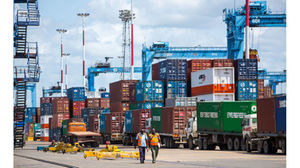
Tanzania Traders Association chairman Khamisi Livembe said improvements at Dar es Salaam Port were encouraging but truck congestion remained a challenge affecting cargo movement. He called for increased use of the Central Railway Line to transport cargo to the Kwala Dry Port in Coast Region, saying this would reduce pressure on roads and improve efficiency.

Mr Livembe also proposed construction of a dedicated dry port facility where trucks could wait before collecting or delivering cargo to reduce congestion. He said improving logistics infrastructure would be critical if Tanzania was to achieve its ambition of becoming a regional production and distribution hub.

Mr Livembe also raised concerns over foreign traders who, he alleged, had moved warehouses outside Dar es Salaam following changes in retail trade regulations while continuing to operate outside the tax system. He said strengthening compliance and fair competition would be important in implementing Vision 2050.

The concerns raised by businesses highlight the wider challenge facing Tanzania’s transformation agenda: creating an attractive investment environment while ensuring fair competition, tax compliance and stronger participation of local enterprises.