Africa must prioritise local production for economic independence, says Namibia President
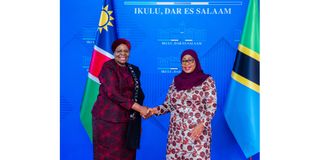
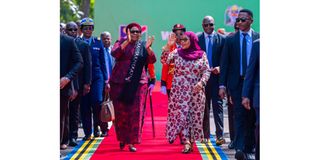
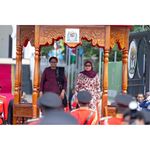
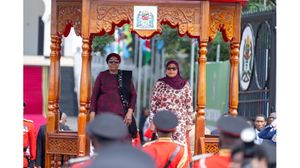
President Samia Suluhu Hassan welcomes Namibia’s President, Dr Netumbo Nandi-Ndaitwah, during a ceremonial reception in Tanzania on June 20, 2026. President Nandi-Ndaitwah is on a State Visit to Tanzania, her second visit to the country following an earlier trip in May 2025.
Dar es Salaam. Namibia President Netumbo Nandi-Ndaitwah has called on African countries to pursue a new phase of economic self-reliance by strengthening domestic production, industrialisation and regional trade instead of relying heavily on external markets.
Speaking at the Tanzania–Namibia Business and Investment Forum organised by the Tanzania Special Economic Zones Authority (Tiseza) in Dar es Salaam on Saturday, June 20, the Namibian leader said Africa must move away from exporting raw materials while importing value-added products.
She said the shift was essential for creating jobs and ensuring sustainable development across the continent.
“Africa's future must be driven by locally produced goods, African industries and the use of African markets. Dependence on external markets has weakened industrial growth and slowed job creation for young people,” she said.
President Nandi-Ndaitwah noted that Africa possesses abundant human resources, a large market and sufficient innovation capacity to build strong economies, but said these opportunities remain underutilised.
She said her arrival in Dar es Salaam had offered a glimpse of vibrant economic activity, which she described as evidence of strong domestic markets with untapped growth potential.
The Namibian leader said initiatives such as the African Continental Free Trade Area (AfCFTA) and Agenda 2063 provide a historic opportunity for the continent to build a stronger integrated market, but stressed that success would depend on increased investment in production and value addition.
She highlighted cooperation opportunities between Tanzania and Namibia in agriculture, mining, manufacturing, tourism, energy and transport sectors.
According to her, Tanzania presents a large and expanding market supported by improving infrastructure, while Namibia offers strong natural resource potential and opportunities for industrial value addition.
President Nandi-Ndaitwah also emphasised the need to strengthen transport connectivity between Dar es Salaam Port and Walvis Bay, describing transport links as a key pillar of regional economic integration between East and Southern Africa.
“Given the rapid global changes driven by technology and emerging industries, Africa has no time to wait. It must act now to avoid being left behind,” she said.
She said the success of economic cooperation should not only be measured by statistics but also by jobs created, skills transferred and improved livelihoods.
Meanwhile, President Samia Suluhu Hassan said economic cooperation between Tanzania and Namibia still lagged behind the strong political and diplomatic relations enjoyed by the two countries.
She said Tanzania continues to improve its investment environment through reforms and institutions such as Tiseza, enabling company registration to be completed within as little as 24 hours.
President Samia Suluhu Hassan welcomes Namibia’s President, Dr Netumbo Nandi-Ndaitwah, during a ceremonial reception in Tanzania on June 20, 2026. President Nandi-Ndaitwah is on a State Visit to Tanzania, her second visit to the country following an earlier trip in May 2025.
President Hassan highlighted ports and transport infrastructure as key drivers of regional integration, noting that Tanzania serves as a gateway for six landlocked countries.
She said expansion works at Dar es Salaam Port, alongside planned projects in Bagamoyo and Mangapwani, were creating opportunities in shipping, logistics and related industries.
In agriculture, President Hassan said Tanzania's vast arable land places the country in a strategic position to supply surplus crops such as rice and maize to Namibia and the wider region.
She also cited opportunities for cooperation in livestock and fisheries, noting that Tanzania has one of Africa's largest livestock populations, while Namibia has developed expertise in meat production and fisheries.
On mining, she said both countries could benefit from joint investments in strategic minerals, including gold, diamonds and uranium, to increase value addition and productivity.
President Hassan also pointed to renewable energy and tourism as areas with strong potential for cooperation, while underscoring the role of Kiswahili in strengthening economic and social ties between the two countries.
She concluded by reaffirming Tanzania's commitment to maintaining a stable, predictable and investor-friendly business environment.