Tanzania, Namibia chart new economic frontier as Samia rallies African unity for development
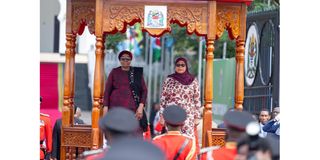
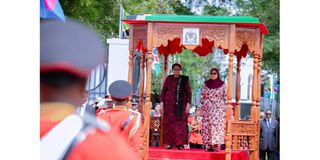
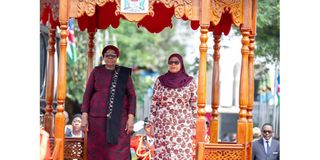
President Samia Suluhu Hassan welcomes Namibia’s President, Dr Netumbo Nandi-Ndaitwah, during a ceremonial reception in Tanzania on June 20, 2026. President Nandi-Ndaitwah is on a State Visit to Tanzania, her second visit to the country following an earlier trip in May 2025.
Dar es Salaam. Tanzania and Namibia have pledged to transform their long-standing liberation struggle ties into a robust economic partnership, with President Samia Suluhu Hassan calling on African nations to embrace unity and cooperation as the continent seeks solutions to its development challenges.
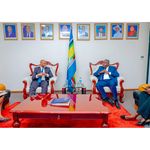
The commitment emerged on June 20,2026 following bilateral talks between President Hassan and Namibia's President, Netumbo Nandi-Ndaitwah, who is on a three-day State Visit to Tanzania.
The two leaders agreed that while Tanzania and Namibia share a rich history forged during southern Africa's liberation struggles, the time has come to deepen economic cooperation and create tangible benefits for citizens in both countries.
Speaking after the talks at State House in Dar es Salaam, President Hassan said Africa possesses immense potential to overcome its challenges if countries work together with the same determination that characterised the fight against colonialism and apartheid.
"Despite the challenges facing Africa, the continent is endowed with enormous opportunities, including a youthful workforce, abundant natural resources and fertile land," she said.
"If African countries cooperate effectively, as we did during the liberation struggle, we will be able to solve many of the challenges confronting us and achieve our development aspirations without fear, without obstacles and without intimidation."
Her remarks came as the two countries signed four cooperation agreements covering trade-small and medium enterprises (SMEs), defence, and municipal cooperation between Zanzibar City and Namibia's Swakopmund.
President Hassan noted that Tanzania remains committed to preserving its historic relationship with Namibia, which dates back to the era when Tanzanians supported Namibia's struggle for independence.
She recalled that President Nandi-Ndaitwah has a personal connection with Tanzania, having lived in Dar es Salaam's Magomeni area during Namibia's liberation movement years.
However, she acknowledged that economic relations have lagged behind the strong political ties.
According to President Hassan, trade between the two countries remained modest, reaching only about Sh20 billion in 2024, while Namibia has only a handful of investments in Tanzania despite decades of diplomatic friendship.
"The current level of economic cooperation does not reflect the strength of our political relations," she said, adding that both governments had agreed to intensify efforts to unlock investment and trade opportunities.
The two leaders identified food security, the blue economy, mining, oil and gas, livestock development and aviation as key sectors for future collaboration.
"We have agreed to strengthen cooperation in strategic areas such as food security, the blue economy, minerals, oil and gas," President Samia said.
She emphasised that closer cooperation in oil and gas was particularly important as African countries seek to navigate an increasingly uncertain global economic environment.
"Considering the changing global economic landscape, we have seen the importance of strengthening cooperation between our countries so that we can protect ourselves, withstand these challenges and benefit from the resources with which we have been blessed," she added.
The leaders also discussed plans to establish direct air links between Tanzania and Namibia to facilitate business travel, tourism and people-to-people exchanges.
Beyond economic matters, the two countries agreed to promote Kiswahili language studies in Namibia's higher education institutions, further strengthening cultural and educational ties.
President Hassan also used the occasion to seek Namibia's support for Tanzania's bid for a non-permanent seat on the United Nations Security Council for the 2029–2030 term, as well as backing for Tanzanian candidates seeking positions in various international organisations.
For her part, President Nandi-Ndaitwah praised Tanzania's historic role in Namibia's liberation struggle and said the relationship between the two countries must evolve to meet modern realities.
"Tanzania should be proud of the role it played in the independence of Namibia," she said.
She stressed that the objective of her visit was to reposition bilateral relations from political solidarity towards economic cooperation capable of improving the livelihoods of citizens.
"The purpose of my visit is to transform our long-standing political relationship into an economic partnership because that is what the world we live in today demands," she said.
The Namibian leader added that the agreements signed during the visit must now be translated into concrete action, particularly through the removal of barriers that hinder trade and investment.
Agreements signed:
Four agreements were signed during the State Visit.
They include a framework agreement on bilateral cooperation between the Governments of Tanzania and Namibia, a memorandum of understanding on cooperation in the development of small and medium enterprises, an agreement on defence cooperation, and a partnership agreement between Zanzibar City Municipality and the Municipality of Swakopmund.
The agreements are expected to provide a foundation for expanding economic engagement between the two countries and unlocking opportunities in sectors with significant growth potential.