African education assessors warn against AI deciding students’ futures
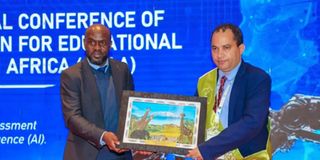
Deputy Permanent Secretary in the Ministry of Education, Science and Technology, Dr Hussein Mohamed Omar (left), presents a gift to the newly elected President of the Association for Educational Assessment in Africa (AEAA), who is also the Executive Secretary of the National Examinations Council of Tanzania (NECTA), Professor Said Mohamed, who will serve as president for the 2026/27 term. The handover took place during the four-day 42nd AEAA Annual Conference held in Arusha.
Arusha. The Association for Educational Assessment in Africa (AEAA) has warned against allowing artificial intelligence (AI) to make decisions that could determine students’ academic futures, saying the technology should support rather than replace professional judgement.
The warning was issued by the Deputy Permanent Secretary in the Ministry of Education, Science and Technology, Dr Hussein Mohamed Omar, when he closed the four-day 42nd AEAA Annual Conference in Arusha.
Dr Omar said AI could provide valuable support in education assessment, but its use must be guided by professional ethics, human oversight and accountability.
“Let us use artificial intelligence to strengthen professional judgement, not to hand over that judgement to AI. Technology should support education professionals and examiners, but should not replace them,” he said.
He warned that using AI without adequate ethical safeguards could compromise the security and credibility of examination systems and widen educational inequalities among African countries.
Dr Omar said AI could not independently determine whether an examination question was culturally appropriate, valid or fair to students from different backgrounds.
The technology, he added, could also not adequately assess whether an examination had taken into account the needs of learners with special educational requirements.
He said the increased use of technology in examinations must therefore be accompanied by stronger cybersecurity, data protection, examination confidentiality, professional ethics and institutional accountability.
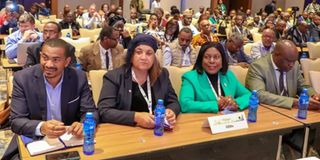
The conference brought together more than 350 delegates from 28 African countries and other parts of the world, including officials from education ministries, examination bodies, assessment experts and other education stakeholders.
Hosted by the National Examinations Council of Tanzania (NECTA), the conference focused on rethinking education assessment systems across Africa to keep pace with rapid technological developments, particularly the growing use of AI.During the conference, Tanzania formally assumed the AEAA presidency for 2026/27 through NECTA Executive Secretary Prof Said Mohamed.
Prof Mohamed received the leadership baton from his predecessor, Dr Ashetu Gichuro of Ethiopia.
After assuming the presidency, Prof Mohamed pledged to promote unity and cooperation among African assessment bodies, stressing the importance of developing joint solutions to challenges facing education assessment on the continent.
He said Africa must also redesign its education systems to respond to the demands of the AI era while maintaining integrity and quality in assessment.
“Africa’s greatest resource is not only its natural wealth, but also its young people who receive quality education. The first and greatest blessing for Africa’s children is quality education. Let us work together to ensure that no child is left behind,” he said.
The conference adopted 11 resolutions, including a call for AI to be used to strengthen assessment while professional judgement and human oversight remain the foundation of decision-making.
The resolutions also called on assessment institutions to develop clear policies and standards governing the use of AI to safeguard transparency, accountability, equity, inclusion and students’ rights.African countries were further urged to strengthen cooperation in AI research, innovation, policy development, cybersecurity and capacity building for professionals involved in digital assessment.
Earlier, while handing over the AEAA presidency, Dr Gichuro urged education stakeholders across Africa to strengthen cooperation and develop assessment systems capable of responding to rapid technological change, particularly the emergence of AI.
She said assessment systems across Africa remained fragmented and relied heavily on final examinations, which did not fully reflect the competencies required in the 21st century.
According to Dr Gichuro, the situation could undermine the implementation of the African Union’s Agenda 2063, which seeks to build an inclusive and prosperous Africa with a stronger role in the global knowledge economy.