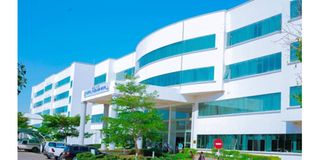
Dar es Salaam. Benjamin Mkapa Hospital (BMH) has launched a Sh7 billion fundraising campaign to finance kidney and bone marrow transplants for 100 underprivileged patients over the next two years.
The initiative seeks to support 50 patients in need of bone marrow transplants, mainly children suffering from sickle cell disease, and another 50 patients with chronic kidney failure.
Speaking to editors from different media outlets on Thursday, May 21, 2026, ahead of the hospital’s 10th anniversary celebrations, BMH executive director Dr Abel Makubi said the government had already provided seed funding, but the growing demand for specialised treatment required wider stakeholder support.
“Our target is to raise Sh7 billion within two years to help patients currently on the waiting list,” said Dr Makubi.
“We already have 50 patients ready for bone marrow transplants and another 50 awaiting kidney procedures. The government has supported us, but the need has increased significantly,” he added.
He said the availability of transplant services locally had reduced treatment costs and helped the country save foreign exchange previously spent on overseas referrals.
He hinted that kidney transplants at BMH cost between Sh40 million and Sh45 million, compared to around Sh60 million abroad.
For bone marrow transplants, he said patients spend between Sh50 million and Sh55 million locally, while similar treatment overseas costs over Sh275 million.
“These procedures require substantial investment, but offering them locally has enabled the country to save large sums of money,” said Dr Makubi.
“Despite the reduced costs, treatment remains beyond the reach of many families, which is why we are appealing to stakeholders and well-wishers to support this initiative,” he said.
Established in October 2015, BMH has expanded its workforce from 20 to 1,073 employees, including 100 medical specialists and 30 super specialists.
“This enabled us to introduce 20 general specialization services and 18 super specializations. Our results are comparable to those achieved in India, Europe, and the United States,” he said.
The government has invested more than Sh283 billion in infrastructure and advanced medical equipment, as the hospital is expected to mark its 10th anniversary on July 15 this year.
Looking ahead, Prof Makubi said the hospital plans to establish a kidney transplant centre of excellence—the first of its kind in sub-Saharan Africa—through Sh28 billion in funding from the Japanese government.
He said another centre, financed by the Tanzanian government, would specialise in the treatment of cancer complications, while funding from the East African Community (EAC) would support the establishment of a Bone Marrow Centre of Excellence.
“Our goal is to ensure that BMH, in collaboration with the University of Dodoma (UDOM), transforms Dodoma into a medical hub and positions Tanzania as a destination for medical tourism,” he said.
Kidney transplant specialist, Prof Masumbuko Mwashambwa, said BMH introduced transplant services in 2018 through a partnership with Japan’s Tokushukai Medical Corporation, due to the longstanding friendship between the late former President Benjamin Mkapa and Dr Torao Tokuda of Japan.
“Before 2017, patients with kidney failure had to travel abroad, mainly to India, for treatment,” said Prof Mwashambwa, noting that those who could not afford the costs received only supportive care, and many eventually died.
He said BMH had so far conducted 56 kidney transplants, although kidney disease remained a growing public health challenge.
“Studies indicate that about 10 percent of people suffer from kidney-related illnesses globally, and one person dies every 20 seconds due to kidney complications,” he said.
High blood pressure and diabetes, he said, are among the leading causes of kidney disease, with about one-third of diabetic patients developing kidney complications.
Prof Mwashambwa noted that although local transplant costs were lower than overseas treatment, many families still struggled to afford the Sh45 million required, in addition to the cost of expensive post-operative medication.
Bone marrow transplant specialist, Dr Stella Malangaya, said BMH was emerging as a centre of excellence for bone marrow transplant services within the East African Community.
She said the hospital had started attracting patients from neighbouring countries, boosting both expertise and medical tourism.
However, she noted that affordability remained a major challenge for ordinary Tanzanians.
“Currently, 50 children are on the waiting list, most of them suffering from sickle cell disease,” said Dr Malangaya.
She added that the fundraising campaign would also support the expansion of treatment facilities from three rooms to six and enable the purchase of specialised equipment.
Tanzania Editors Forum (TEF) chairman, Mr Deodatus Balile, said Tanzania is making significant progress in specialised medical treatment, praising recent surgical successes and noting outcomes had exceeded negative narratives circulating on social media.
He urged Tanzanians to support the Sh7 billion fundraising campaign through the power of the media to secure a better future.
Tanzania Information Services Department (Maelezo) acting director, Mr Rodney Mbuya said the BMH brand had earned public trust and called on journalists to educate citizens and publicise government services.