Chadema's Mnyika takes stand in Lissu treason cross-examination
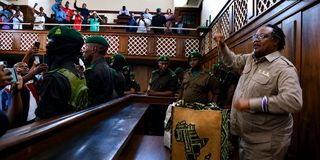
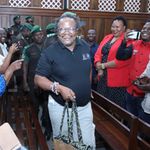
Chadema chairman Tundu Lissu greets party supporters who turned up at the High Court’s Dar es Salaam Registry on September 2, 2026, to follow the treason case against him. State attorneys continued cross-examining the party’s secretary-general, John Mnyika, during the hearing. PHOTO | SAID POWA
Dar es Salaam. Events from the 2025 General Election emerged in the treason trial of Chadema national chairman Tundu Lissu, as state prosecutors questioned a defence witness over the poll and post-election violence.
The cross-examination took place on Tuesday, September 1, 2026, when Chadema Secretary-General John Mnyika was grilled on his chief evidence given in court under oath.
Mr Lissu faces treason charges alleging that on April 3, 2025, as a Tanzanian citizen, he seditiously incited the public to prevent the 2025 General Election by uttering and publishing online statements to pressure the head of government.
The trial is before a three-judge panel of the High Court, Dar es Salaam Sub-Registry, led by Justice Dunstan Ndunguru alongside Justices James Karayemaha and Ferdinand Kiwonde.
The matter is at the defence stage, with the prosecution cross-examining defence witnesses.
State attorneys pressed Mr Mnyika to link statements allegedly uttered by Mr Lissu with acts of violence during and after the 2025 General Election.
Senior State Attorney Nassoro Katuga sought clarification on Mnyika’s evidence regarding the political environment leading up to the election.
The cross-examination also probed the nexus between Mr Lissu’s pre-election utterances and subsequent election-period events.
Part of the exchange between State Attorney Katuga and Mr Mnyika proceeded as follows:
Counsel: Witness, in your understanding, what does the word rebellion mean?
Witness: It means opposing or rejecting with great force.
Counsel: Tell the judges, inciting rebellion against an election, what is your interpretation?
Witness: Rejecting or opposing an election through democratic means.
Counsel: Tell the judges whether you prepared to participate in the election according to the Constitution.
Witness: The current Constitution has shortcomings.
Counsel: Witness, are you sane? You will answer this question, I repeat. Tell the judges whether you prepared to participate in the election according to the Constitution.
Witness: We prepared, despite the constitutional shortcomings.
Counsel: Tell the judges if in your evidence, you stated that Chadema Chairman Tundu Lissu said he would block the election through democratic means?
Witness: I do not recall.
Counsel: Tell the judges whether inciting rebellion is a democratic way.
Witness: Yes, it is a democratic way.
Counsel: Tell the judges whether opposing an election with all force is a democratic way.
Witness: All ways of opposing an election are democratic.
Counsel: Witness, do you accept that other parties had the right to participate in the 2025 general election?
Witness: Yes, they have a right to participate in a free and fair election.
Counsel: Witness, would I be correct that your chairman in his speech on that day (April 3, 2025), saying "we will cause havoc, we will go and block the election, we will incite rebellion", aimed to pressure the government to make legal amendments you felt necessary?
Witness: No.
Counsel: Tell the judges if you know that in the 2025 general election there was an attempt to block it by burning polling stations and infrastructure...
Witness: I do not know.
Counsel: Is it correct, in your belief, that last year there was no election, proving the intention to block it?
Witness: It is not correct.
Counsel: Do you know whether on October 29, 2025, private property was set on fire?
Witness: I do not know, I only heard.
Counsel: Is it right or not right for the public to interpret and act on words spoken by your chairman in blocking the election?
Witness: It is their right.
Counsel: Would I be correct to say it is right for the public to be incited and burn polling stations or chop off people's fingers to exercise that right?
Witness: It is not right.
Counsel: Witness, do you know whether some Rapid Transit (mwendokasi) stations were set on fire?
Witness: I know, I saw them.
Counsel: Tell the judges whether it is correct or not for the public to interpret Mr Lissu's words of April 3, 2025 through actions?
Witness: Which actions?
Counsel: Is it true that the government is the enforcer of those laws?
Witness: It is true.
Counsel: Witness, tell the court, is threatening to break the law threatening the enforcer?
Witness: It is not correct.
Counsel: Tell the judges, in threatening to break the law, who are you threatening: the court or who?
Witness: You threaten the victim, and it is not necessarily the government.
Counsel: Tell the court whether the government, as the enforcer, can be a victim?
Witness: It is not correct.
Counsel: Tell the judges whether you heard the report of Justice Othman Chande's Commission stating those events resulted from youth being incited by politicians who wanted electoral law changes.
Witness: I heard.
Counsel: Tell the judges whether that speech resembles what your chairman said about inciting the public to block the election?
Witness: They do not resemble.
Counsel: Tell the judges what changes your chairman, Mr Lissu, said he would encourage. If changes to food, to the stomach, say so; what changes did he want?
Witness: Changes through democratic means.
Counsel: Tell the judges, when Justice Chande said those riots resulted from youth being incited by politicians, how do they differ from the words spoken by your chairman?
Witness: The Chairman was not involved.
Counsel: Do you know the organs responsible for maintaining peace in this country?
Witness: I know them.
Counsel: Can you help the judges list them?
Witness: The Police Force, the Tanzania People's Defence Force (TPDF), and National Security.
Counsel: Under whom are those organs?
Witness: They are under the President.
Counsel: Therefore, if a person threatens peace, is he threatening the President and his organs?
Witness: It is not true.
Counsel: Setting fire to property, destroying infrastructure, burning polling stations, chopping off fingers, are all these breaches of peace?
Witness: According to the law?
Counsel: Answer the question.
Witness: I do not know.
Counsel: Tell the Court, as an executive of the party, did you step forward to oppose a Chadema member named Ishengoma?
Witness: I know nothing.
Counsel: Tell the Court if you know, or heard from Justice Chande's speech, whether the election and post-election violence was coordinated?
Witness: I do not know.
Counsel: Do you know if after the election violence, some people were arrested in connection with that violence?
Witness: They were arrested, then released.
Counsel: Do you know whether those people were brought to court for treason offences after being arrested?
Witness: I saw it in the media.
Counsel: Tell the judges if you know the accused stated in police station interviews that they committed those acts due to statements made by Mr Tundu Lissu?
Witness: I do not know.
Counsel: As party secretary, did you ever conduct an interview with anyone facing treason charges?
Witness: I have never.
Counsel: Do you know regarding the member who called journalists and explained what was planned by the party and what happened during the election?
Witness: I do not know.
Counsel: Do you know that the member told the public those plans were coordinated by the party?
Witness: I do not know.
Counsel: Do you know this Chadema member said in his statement there were special phone systems to communicate information to accomplish that plan?
Witness: I do not know.
Counsel: Tell the honourable judges if you ever stepped forward to oppose this Chadema member named Shengoma regarding involvement in the October events.
Witness: I do not know him.
The case continues today, Wednesday, September 2, 2026.
Register to begin your journey to our premium contentSubscribe for full access to premium content